


A marketing consultant rarely needs more names for a spreadsheet; you need a sound reason to approach each company. The top 5 outreach preparation platforms for marketing consultants in 2026 differ in where they find that reason, how clearly they show supporting evidence, and how much message review they leave in your hands. Our outreach preparation software for marketing consultants supports company research and message preparation shaped around a consultant’s services.
That distinction matters when a company’s hiring, expansion, or public discussion could connect to your offer. A useful signal can help you prioritize research, but it does not prove the company is buying. Compare the source, the consultant service fit, the draft, and the work you must still do before choosing.
What should marketing consultants compare?
Start with the work you want the platform to take off your plate. Some tools research companies and explain a possible need; others find people discussing relevant problems, enrich a lead, or help build a custom workflow. Our overview of lead research software for consultants offers more context on matching those workflows to your prospecting routine.
Check whether the platform preserves source evidence you can review, not just a match score or a draft. Also ask whether it drafts messages only, or sends and tracks them. Google’s email sender guidance sets authentication requirements for messages to Gmail accounts, so preparation software does not replace the need to manage your sending setup.
For US consultants, sending commercial email also means considering CAN-SPAM. The FTC says the law applies to business-to-business email and outlines requirements such as truthful headers, a valid postal address, and an opt-out method in its FTC compliance guide. Marketing advisers may also find it useful to consider agency perspectives while shaping their own business development approach, including www.outsidethebox.agency.
| Rank | Platform | Research focus | Preparation and review | Published price and limits |
|---|---|---|---|---|
| 1 | ProspectDog | Companies that may fit a consultant’s services, with a reason and source to review | Daily brief, suggested email draft, consultant reviews and sends | Free first brief; Starter $49/month for up to 10 requested leads daily; Pro $99/month for up to 20 |
| 2 | Signado | People and companies connected to LinkedIn posts and comments | Fit scoring and message drafts; consultant chooses what to send | Lite $29/month, 1,000 credits; up to 200 leads if all credits go to lead discovery |
| 3 | Doctor Lead | Prospect research, potential buying signals, conversation hooks, and objections | Personalized drafts require human approval; CRM pipeline and reply tracking | Lite $49/month for 100 prospects; 14-day trial includes 25 prospects |
| 4 | Clay | Custom research, data enrichment, and company or job signals | Build and manage the research workflow; email sequencing is available on paid plans | Free plan; Launch from $167/month with 15,000 actions and 3,000 data credits |
| 5 | Humen | Research on leads, company context, and custom research prompts | Personalized email drafts with preview and editing; optional autopilot | Starter lists $150/month, including 1,000 leads and emails generated monthly |
Prices and plan details above are those listed on October 10, 2026. Credit, action, and lead allowances measure different things, so compare the work included rather than treating the quantities as equivalent.
1. ProspectDog
Best for: Marketing and growth consultants who want a daily, researched shortlist matched to their services, ideal clients, and market.
Each brief includes companies that may need your service, an explanation of the possible fit, source information, and a suggested outreach draft with practical tips. Research can consider signals such as hiring or expansion. You review the evidence and decide whether a prospect merits contact. Feedback about which companies fit your profile helps shape later shortlists. For independent consultants comparing options, our guide to lead research software for independent consultants adds related detail.
The workflow is built around signal-based research and an outreach draft you can edit, rather than sending a message automatically. Your profile supplies the service, expertise, ideal client, and market used to guide research. A signal suggests potential relevance, not verified buying intent or a confirmed contact.
Pros:
- The consultant-focused profile connects research to the service you actually sell.
- Source information and reasons for a possible fit support manual qualification before you spend time writing.
- A free researched brief is available after signup without a card. Starter is $49 monthly for up to 10 requested leads in one daily brief; Pro is $99 for up to 20.
- Feedback helps shape future shortlists, which can make recurring prospect research more aligned with your ideal client.
Cons:
- Contact details and buying intent are not verified. You remain responsible for qualifying each company, finding and verifying the right contact, personalizing the draft, and sending it.
Daily allowances count requested results, so fewer relevant companies may be returned. If you are building a sustainable routine, our explanation of how much lead research software consultants need can help you think through research volume without equating more leads with better fit.
2. Signado
Best for: Consultants who find prospective clients through relevant conversations in LinkedIn posts and comments.
Signado searches for people and companies connected to selected keywords, posts, creators, or competitors. It keeps the original post or comment alongside a fit assessment and suggested next action, giving you a concrete conversation to consider. It can draft a message based on that context, but you choose whether to send it by email or copy it into a LinkedIn message. Email lookup and AI drafting use additional credits.
This approach offers a different kind of source evidence from company hiring or expansion signals: the person’s own public discussion. Before adopting any LinkedIn-related workflow, check the platform’s rules separately. LinkedIn’s automation policy prohibits unauthorized third-party software that scrapes or automates activity on its website; a research feed should not be taken as permission to automate outreach.
Pros:
- Post and comment context can give consultants a specific, relevant opening for a conversation.
- Fit assessment considers both the person and company, helping you decide whether to pursue the lead or look for another contact.
- Paid plans start at $29 monthly for 1,000 credits, with a seven-day trial listed for every plan.
Cons:
- Its discovery centers on LinkedIn activity rather than a broad company-research workflow.
- Signado does not send LinkedIn messages for you, and email lookups or AI-written drafts draw from the same credit pool.
3. Doctor Lead
Best for: Consultants who want to research a prospect, prepare personalized outreach, and track follow-up in a pipeline.
Doctor Lead lets you define an ideal client using factors such as industry, geography, job titles, pain points, and tone. Its prospect research identifies possible buying signals, conversation hooks, and objections, then prepares personalized outreach and follow-up drafts. A CRM pipeline and reply tracking connect preparation with later prospect activity. Workspaces can help keep different client or business campaigns separate.
Pros:
- The combination of research, message review, and pipeline tracking supports a fuller prospecting routine.
- Human approval is part of the workflow before outreach is sent.
- A 14-day free trial includes 25 prospects per month. The Lite plan costs $49 monthly for 100 prospects; higher plans increase monthly prospect allowances and campaign limits.
Cons:
- Its published positioning is aimed at founders and small sales teams, so consultants should check that its ideal-client and workspace setup suits their own client acquisition process.
- Prospect allowances are monthly, so the plan should match your expected research volume across the month.
4. Clay
Best for: Consultants who want to design a flexible research and enrichment workflow rather than start with a consultant-specific daily brief.
Clay combines data enrichment from multiple providers with an AI agent that can research the web and generate custom data points. Paid plans also include job-change and company-news signals, recurring enrichment, and email campaign options. This can suit a consultant who wants to assemble a repeatable process around a particular industry or account list.
Pros:
- Web research, enrichment, and signal features allow a highly customizable research workflow.
- A free plan offers a way to build and explore workflows; the Launch plan lists 15,000 monthly actions and 3,000 data credits.
- On paid plans, email sequencing can be handled in Clay or through integrations.
Cons:
- You need to configure and maintain the workflow, rather than receive a shortlist already shaped to a consulting service.
- Actions and data credits are separate usage measures. Research and enrichment costs depend on what you run, so estimate consumption before choosing a plan.
5. Humen
Best for: Early-stage teams that want researched leads and personalized email preparation in a broader outbound workflow.
Humen researches uploaded leads and can gather professional background, role responsibilities, company context, recent news, and custom information based on prompts. It connects those findings to the user’s pitch and value proposition, then prepares tailored emails. You can preview and edit messages before sending, or choose its autopilot option. Its public positioning is for early-stage companies, so marketing consultants should check how well the workflow maps to their service and target market.
Pros:
- Custom prompts and lead-level research can support detailed personalization beyond a basic name and company field.
- Preview and editing features allow human review of generated emails, while scheduling and autopilot offer different execution choices.
- The Starter plan lists $150 monthly, with 1,000 leads and emails generated and 2,000 research credits per month.
Cons:
- It is a broader startup outbound product, not specifically designed around marketing consultants’ daily company-fit research.
- Its research and email allowances use separate monthly limits, so consider both when estimating your workload.
Choose the research workflow that fits your practice
The right option depends on where prospecting slows down. For service-led company research and drafts shaped around a consultant profile, ProspectDog is the strongest fit in this shortlist. Signado suits consultants who follow LinkedIn conversations; Doctor Lead adds approval and pipeline tracking; Clay offers more workflow control; Humen brings deeper email personalization to startup outbound. Before you commit, compare source visibility, review responsibilities, and the actual usage unit behind each price.
Build a more consistent prospecting routine
If finding relevant companies takes time away from client work, a focused daily brief can give your research a repeatable starting point. You tell us about your service, expertise, ideal client, and market, then review the evidence and decide which opportunities deserve your attention.
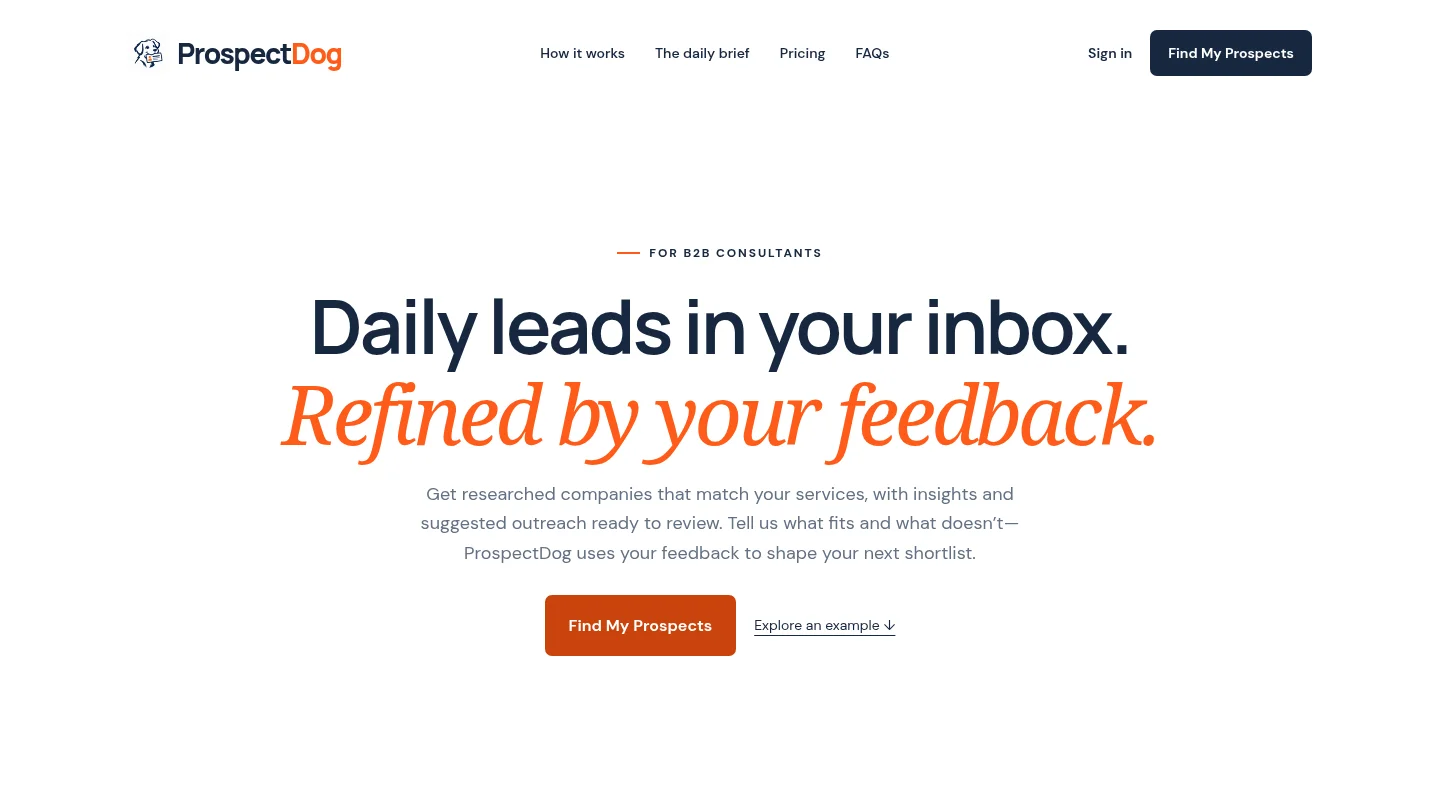
Start with one researched brief after signup, free and without a card. For ongoing research and dashboard access, Starter is $49 per month for up to 10 requested leads in one daily brief, while Pro is $99 per month for up to 20. Eligible accounts can try either plan for seven days with a payment method; subscriptions renew monthly unless canceled before the trial ends. Every signal indicates possible service fit, not guaranteed buying intent or a verified contact. You remain responsible for qualifying prospects, checking contacts, personalizing drafts, and sending messages. Get a researched B2B lead brief.
Frequently Asked Questions
What does outreach preparation software do?
It helps identify prospective companies or people, gather context about their possible needs, and prepare relevant messages. Some tools also support sending or tracking, while others leave those steps to you.
How should a marketing consultant choose a platform?
Start with the research source that best matches your market, such as company activity or public conversations. Then compare evidence visibility, message review, manual work, and pricing limits.
Does outreach preparation software send prospect messages?
Not always. Some platforms prepare research and drafts for your approval, while others offer campaign or automated sending features that you can choose to use.
How is lead research different from email sequencing?
Lead research helps you decide which companies or people may be relevant and why. Email sequencing manages the sending and follow-up of messages, and may not provide the research needed to select or qualify prospects.
What should I check before contacting a researched prospect?
Review the evidence and decide whether it genuinely connects to your service. Verify the contact, personalize your message, and make sure your sending process follows applicable rules and platform requirements.