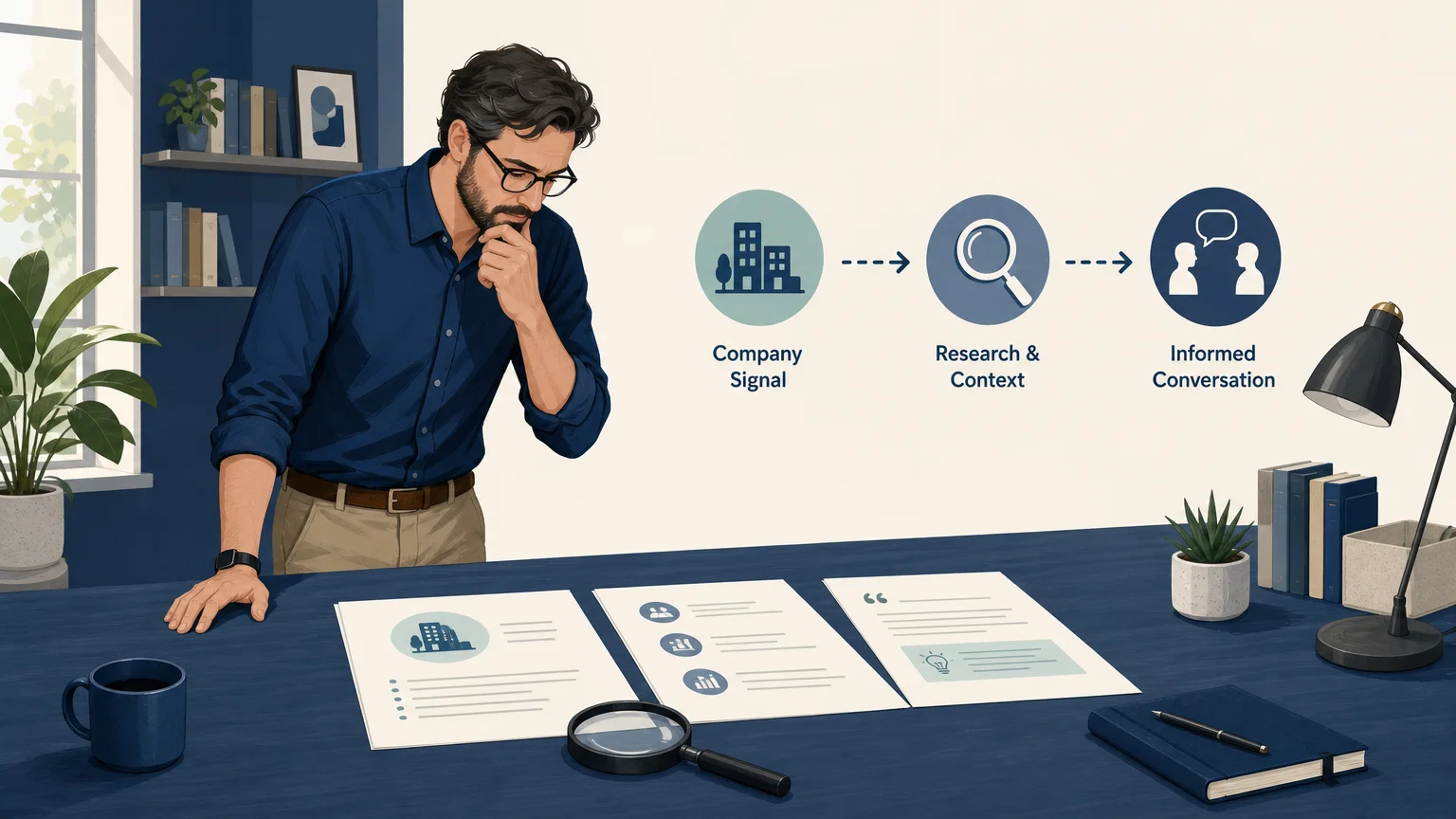


The practical answer to How much lead research software do consultants need for daily prospecting? is usually less than a full sales stack. You need enough relevant prospects to maintain a consistent pipeline, but not so many that research quality and follow-up collapse. If you are weighing the investment, our explanation of whether lead research software is worth it for consultants can help you frame the decision around time saved and work retained.
A solo consultant often benefits from a focused daily workflow rather than a large contact database. Your software should identify companies that may fit your offer, explain the evidence, and help prepare a thoughtful first message. It should not replace qualification, contact verification, personalization, or professional judgment.
How much daily research capacity do you actually need?
Start with the number of conversations you can realistically handle, not the number of records a platform can display. If you can conduct only three meaningful discovery calls each week, receiving hundreds of unqualified companies creates administrative work rather than pipeline.
For many independent consultants, a useful starting range is 5 to 10 researched companies per day. This provides enough choice to reject weak matches while preserving time for evidence review and follow-up. Consultants with a broader market, a repeatable offer, or support from an assistant may use 10 to 20 daily research results.
Your practical capacity depends on four limits:
- Research depth, meaning how much company context you need before outreach.
- Qualification workload, including fit checks, source review, and disqualification.
- Contact discovery and verification, which may remain manual even when company research is automated.
- Personalization and follow-up, which determine whether a researched company becomes a genuine conversation.
A simple rule is to request no more daily leads than you can review carefully within one working session. If reviewing 10 companies takes two hours and leaves no time for outreach, the volume is too high. If you finish reviewing three companies quickly and still lack enough conversations, increase capacity gradually.
Why a smaller, better-researched list often works better
Consulting is a trust-based purchase. Prospects need to see that you understand their situation before they invest time in a conversation. A large list built from broad filters may identify companies that resemble your ideal client, but resemblance is not the same as a timely service need.
A 2025 Gartner survey found that 61% of B2B buyers preferred a buying experience without a sales representative. That finding does not mean consultants should eliminate outreach. It means your first interaction must respect the buyer’s research process and provide enough relevance to justify a response. Gartner's 2025 survey supports a quality-first approach to prospecting.
For a specialist consultant, 5 well-supported opportunities can be more useful than 50 generic names. A researched account should answer three questions:
- Why might this company need your service?
- What public evidence supports that conclusion?
- What would make a first conversation useful rather than intrusive?
This is also why software should prioritize companies and situations, not simply contacts. A contact database can tell you who works at a business. It may not explain why the company deserves your attention today.
Match software volume to your consulting offer
Different consulting offers require different research intensity. A narrowly defined service for a specific industry usually benefits from fewer, deeper opportunities. A broader marketing, operations, or automation offer may justify a wider daily search, provided your qualification criteria remain clear.
| Consulting situation | Practical daily range | Recommended research depth |
|---|---|---|
| High-value, customized engagements | 3 to 7 companies | Detailed evidence, decision-maker research, and account-specific messaging |
| Focused specialist offer | 5 to 10 companies | Clear service fit, trigger review, and contact verification |
| Repeatable consulting package | 10 to 20 companies | Consistent qualification criteria with lighter initial research |
| Multi-market consulting practice | 10 to 20 companies per segment | Segmented searches and separate messaging for each market |
These are operating guidelines, not universal benchmarks. Your conversion history should refine them. If 10 daily leads produce only one suitable conversation each month, improve the targeting before increasing the volume. If 5 daily leads consistently create more qualified conversations than you can serve, reduce the allowance or narrow the search.
For consultants who want research and message preparation in one workflow, our lead research and outreach preparation software explains how a daily brief can support the transition from company research to a reviewed first message.

Use software for evidence, not for final qualification
Lead research software can reduce the time spent searching company websites, news pages, hiring pages, and market signals. It cannot determine whether a prospect is genuinely suitable for your commercial offer without your review.
A useful daily brief should provide a reason for considering the company, a source to inspect, and enough context to shape a relevant opening. You should still verify the company, identify the appropriate contact, assess timing, and decide whether the outreach is appropriate.
This distinction matters because a research signal is not verified buying intent. A hiring announcement may indicate expansion, but it does not prove that the company wants consulting support. A new service launch may suggest a need, but it does not confirm budget or authority. Treat these signals as prompts for investigation, not as permission to send an automatic pitch.
Salesforce describes prospecting as the process of identifying and engaging potential buyers before a sales opportunity exists. Its Salesforce prospecting guide reinforces the importance of combining targeting, preparation, and engagement instead of treating list creation as the complete sales process.
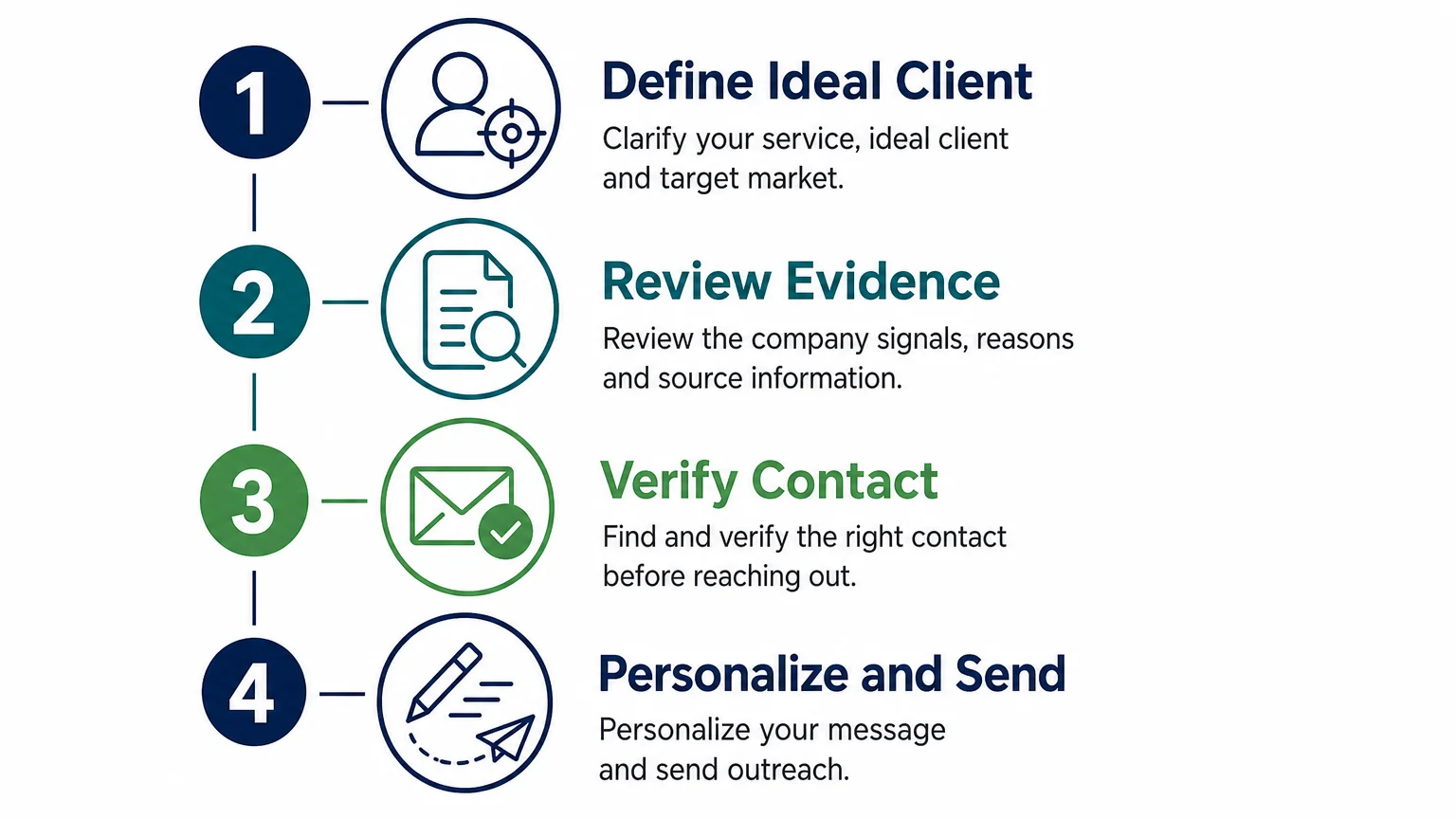
The best workflow separates software assistance from consultant responsibility:
- The software finds a potentially relevant company.
- You review the source and service-fit explanation.
- You locate or verify the right contact.
- You adapt the draft to the company and person.
- You send the message through your own email account.
That division protects your credibility. It also makes the software easier to evaluate, because you can measure the time it saves without pretending that it performs the entire sales cycle.
Calculate the right amount from your pipeline math
Your target volume should connect to your revenue goal. Begin with the number of new clients you need, then estimate the number of qualified conversations required to win them. From there, work backward to the number of researched companies you must review and contact.
For example, suppose you want two new projects each month. If one in four qualified conversations becomes a client, you need about eight qualified conversations. If one in ten reviewed prospects becomes a qualified conversation, you need approximately 80 reviewed prospects across the month.
That calculation does not mean you should contact 80 companies automatically. It tells you how much research capacity your process may require. You might need 4 carefully researched companies on each working day, or 10 lighter-fit companies if your offer and market support broader outreach.
Track these measures separately:
- Companies researched.
- Companies accepted after review.
- Contacts verified.
- Messages sent.
- Qualified replies.
- Sales conversations held.
- Opportunities created.
Separating these stages prevents a common mistake. A tool may deliver 20 researched companies, but that does not mean you have 20 qualified leads. Your usable number is the group that survives evidence review, fit assessment, contact verification, and your own capacity check.
When a daily brief is enough for a consultant
A daily brief is usually enough when your main bottleneck is finding suitable companies and turning research into a repeatable starting point. It is particularly useful when you already understand your offer but struggle to maintain a steady prospecting routine.
In October 2026, our Starter plan provides up to 10 requested leads in one daily brief, while Pro provides up to 20. Both plans include researched companies, evidence, suggested outreach drafts, conversation tips, saved preferences, and lead history. The allowance counts requested results, so fewer relevant companies may be returned when the search finds limited fit.
The right plan depends on your review capacity. Starter is more suitable when you are prospecting alone and want a manageable daily queue. Pro is more suitable when you serve several segments, have more outreach capacity, or want a larger pool from which to select.
Our process is designed to keep the consultant in control. You review the source, decide whether the company fits, find or verify the contact, personalize the draft, and send the message yourself. Starter and Pro do not send prospect emails, replies, or follow-ups autonomously.
For marketing specialists who need a more specific explanation of this workflow, our outreach preparation software for marketing consultants shows how research, evidence, and draft preparation can support a consistent routine without removing human review.
How to test whether the software volume is right
Run a two-week test using the smallest practical plan. Keep your ideal client profile, market, service description, and qualification criteria consistent throughout the test. Changing all four at once makes the results difficult to interpret.
Measure both productivity and quality. Record how long it takes to review each company, how many results fit your service, how many contacts you can verify, and how many personalized messages you can send without rushing.
Consulting Success recommends reserving a consistent daily block for activities such as speaking with prospective clients, networking, and requesting introductions. Its Consulting Success guidance supports the broader principle that prospecting software works best when it strengthens a routine rather than replacing one.
At the end of the test, ask:
- Did the software reduce searching time?
- Did the research provide credible reasons to reach out?
- Could you review the daily results without lowering your standards?
- Did you have enough time to verify contacts and personalize messages?
- Did the workflow create more qualified conversations?
If the answer is no, increasing the number of daily leads will probably not solve the problem. Improve the profile, adjust the market, narrow the service fit, or choose a workflow that provides more useful evidence before adding volume.
Choose capacity that you can sustain
The right amount of lead research software is the amount that produces enough evidence-led prospecting without overwhelming your review and outreach capacity. For many consultants, that means starting with 5 to 10 researched companies per day, then moving toward 10 to 20 only when qualification, contact verification, and follow-up remain manageable. Treat software as a research assistant, not a substitute for judgment. The most valuable system is the one you can use consistently, inspect carefully, and connect to real conversations.
Build a daily prospecting routine
If your main challenge is maintaining a steady flow of relevant companies, a focused daily brief can remove much of the repetitive searching. We help B2B consultants turn their service, ideal client, and market into a repeatable research routine, while keeping qualification and outreach review in their hands.
Get your first researched brief free after signup, with no card required. For ongoing research and dashboard access, Starter is $49 per month for up to 10 requested leads per day, while Pro is $99 per month for up to 20. Eligible accounts may receive a seven-day trial with a payment method. Get your first researched brief and review whether the workflow fits your daily capacity.
Frequently Asked Questions
How many prospects should a solo consultant research each day?
Many solo consultants can begin with 5 to 10 researched companies per day. Increase the volume only when you can still review evidence, verify contacts, personalize messages, and follow up consistently.
Is more lead research always better?
No. More research creates value only when the additional companies remain relevant and usable. A smaller list with clear service fit is often more practical than a large list that requires extensive filtering.
What should lead research software do for consultants?
It should help identify potentially relevant companies, explain why they may need your service, provide source evidence, and prepare a draft for review. You should still qualify the company, verify the contact, personalize the message, and send it yourself.
How does ProspectDog fit into a consultant’s daily workflow?
Our service delivers a daily email brief with researched companies, evidence, suggested outreach, and conversation tips. Starter supports up to 10 requested leads per day, while Pro supports up to 20, with the consultant responsible for final review and sending.
When should a consultant upgrade to a larger research plan?
Upgrade when your current daily allowance limits the number of suitable companies you can review, not simply because a larger number is available. You should also have enough time to qualify, verify, personalize, and follow up with the additional prospects.