


An operations consultant does not need the largest contact database. The practical advantage comes from finding companies with a visible process, capacity, or automation issue, then deciding whether it matches your service. For that workflow, best lead research software for consultants starts with company relevance and evidence, not list size.
The best lead research software for operations consultants should let you define an ideal client, surface a credible reason for outreach, and show what work remains yours. A platform cannot replace judging whether a hiring or expansion signal points to a solvable operational problem. Before buying, specify your target sectors, company size, geography, and service. The Small Business Administration’s market research guidance also recommends defining your target market and reviewing the competitive landscape.
Which platform fits your operations consulting practice?
For an independent operations consultant who wants company research shaped around a specific service, ProspectDog is the strongest fit in this selection. It provides a daily brief with researched companies, source information, potential service-fit reasons, and outreach drafts to review. , Clay, and Sales Navigator offer different levels of database, enrichment, and self-directed research; enterprise platforms suit broader account programs.
| Rank | Software | Research focus | Work you retain |
|---|---|---|---|
| 1 | ProspectDog | Daily company research tailored to your service, expertise, ideal client, and market | Review evidence, qualify companies, verify contacts, personalize and send |
| 2 | Company and contact discovery with prospecting and outreach tools | Assess operational fit and review contact details | |
| 3 | Clay | Configurable research, data enrichment, and prospecting workflows | Build workflows and interpret company evidence |
| 4 | LinkedIn Sales Navigator | Account and lead search using professional and company filters | Connect profile and company activity to your service fit |
| 5 | B2B data, company discovery, and market signals | Set criteria and decide how to act on signals | |
| 6 | SyncGTM | Multi-source data, enrichment, signals, and GTM workflows | Configure workflows and qualify each company |
| 7 | ZoomInfo Sales | Company, contact, account, and buying-signal research | Judge consulting fit and review contact information |
| 8 | Cognism | B2B account and contact intelligence | Check market coverage and confirm service fit |
| 9 | Prospect search, contact enrichment, verification, and outreach | Assess company need and supervise outreach | |
| 10 | Company discovery, contact search, and email verification | Assess company context and qualify the prospect | |
| 11 | LeadIQ | Prospect capture, contact enrichment, and sales workflows | Research the operational issue behind the account |
| 12 | 6sense | Account intent, prioritization, and coordinated GTM activity | Configure target accounts and interpret signals |
| 13 | Demandbase One | Account-based signals, buying groups, and coordinated programs | Manage the broader account workflow and assess fit |
1. ProspectDog
Best for: Independent operations consultants who want a daily shortlist connected to their specific service and ideal client.
We research companies that may match your offer, expertise, ideal client, and market. Each brief includes source information, a reason the company may need your service, a suggested outreach draft, and practical conversation tips. Signals such as hiring or expansion suggest potential service fit; they do not establish buying intent or verified contacts. Feedback about which companies fit can shape later shortlists. Read more about lead research software for independent consultants.
Starter costs $49 per month and includes one daily brief with up to 10 requested leads. Pro costs $99 per month and includes up to 20 requested leads in one daily brief. Fewer relevant companies may be returned than the number requested. You can receive one researched brief after signup without a card. Eligible accounts may also have a seven-day trial with a payment method.
Pros
- Service-fit evidence: Company research is shaped around your consulting offer and ideal client, rather than relying only on broad database filters.
- Daily preparation: The brief brings company context, sources, draft outreach, and conversation tips into a repeatable review routine.
- Feedback-shaped shortlists: Your feedback about suitable and unsuitable companies can guide subsequent research.
Cons
- You remain responsible for reviewing sources, qualifying prospects, finding or verifying contacts, personalizing drafts, and sending messages.
- The daily allowance counts requested results, so a brief may return fewer relevant companies.
2.
Best for: Consultants who want to search company and contact data, then manage prospecting and outreach in a broader sales platform.
combines company and contact discovery with prospecting workflows. Its current product materials describe account and contact information, buying signals, enrichment, and outreach tools. That combination suits consultants who prefer to assemble their own research and contact lists rather than receive a service-specific daily shortlist.
Pros
- Brings company and contact search together with prospecting and outreach functions.
- Useful when you want to build a list and continue into a separate outreach workflow within the same platform.
Cons
- You must decide whether each account has an operations problem your service can solve; database matches alone do not establish that connection.
- The broader sales workflow may be more than you need if your main requirement is a small, researched daily shortlist.
3. Clay
Best for: Consultants who want to create custom research and enrichment workflows using multiple data sources.
Clay is a flexible research and workflow platform. Its product materials describe a data marketplace, agents, and visual workflows for finding information, researching accounts, scoring prospects, and preparing outreach. This flexibility is useful when your ideal client profile requires unusual research fields or several sources. It also places more responsibility on you to define the steps that identify relevant operations needs.
Pros
- Supports custom research workflows and combinations of company and prospect data.
- Can suit consultants who already know which signals or company details they want to collect.
Cons
- You need to design and maintain the workflow that translates your consulting offer into useful research criteria.
- Its flexibility is less direct than a ready-to-review brief if you prefer not to configure research processes.
4. LinkedIn Sales Navigator
Best for: Consultants who prefer hands-on searches for companies and decision-makers using professional and account filters.
Sales Navigator offers separate searches for leads and accounts. Filters include industry, company headcount, geography, seniority, job title, and company activity. You can save searches and accounts, then use updates to spot changes. That makes it useful for identifying potential companies and the people associated with them, especially when you want to check professional context yourself.
Pros
- Account and lead filters help narrow searches by company attributes, role, and location.
- Saved searches and account updates support ongoing, self-directed prospecting.
Cons
- You still need to research why a company might need operations consulting and connect that evidence to your offer.
- It is a hands-on search workflow, not a service-specific daily research brief.
5.
Best for: Consultants with a data-led approach to finding companies and exploring market signals.
Explorium describes a B2B data platform with company and professional profiles, multiple data sources, and signals for account discovery. Its materials also describe natural-language inputs and tools for research workflows. This can help when you want to search for a defined company type or test several market signals. The value depends on how clearly you can specify what counts as a useful operations prospect.
Pros
- Supports company and prospect discovery across multiple kinds of business data.
- Offers signal-based research that can inform the timing and selection of accounts.
Cons
- You must decide which signals matter for your service and how to turn them into a practical prospecting routine.
- It is better suited to users who want to work with data and research workflows than those seeking a ready-made shortlist.
6. SyncGTM
Best for: Consultants who want multi-source prospect data and configurable workflows for research, enrichment, and follow-up.
SyncGTM describes workflows that combine data from multiple providers with company signals, prospect scoring, and GTM actions. The platform can suit a consultant who wants to connect research with other tools or automate repeatable account checks. Its wider orchestration approach is most useful when you have a defined process to run, not simply a need for a daily list of possible clients.
Pros
- Combines several data and signal sources within configurable workflows.
- Can connect account research with enrichment and broader GTM processes.
Cons
- You need to set criteria and build workflows around your consulting service.
- Its broad orchestration focus may exceed the needs of a solo consultant with a straightforward prospecting routine.
7. ZoomInfo Sales
Best for: Consultants who need extensive company and contact research or work with larger target accounts.
ZoomInfo Sales combines B2B company and contact information with account intelligence, intent signals, and tools for organizing sales workflows. Its breadth can help when you need to investigate multiple stakeholders or compare companies at scale. For operations consulting, the important test is whether the evidence helps identify a specific process, capacity, or growth challenge, rather than merely adding detail to an account profile.
Pros
- Offers a broad research environment for company, contact, and account-level information.
- Account insights can support research involving multiple stakeholders or larger organizations.
Cons
- The platform’s breadth may be disproportionate if your practice needs only a short, individually reviewed prospect list.
- You still need to interpret account information and establish why your operations service is relevant.
8. Cognism
Best for: Consultants comparing B2B account and contact intelligence for a defined set of target markets.
Cognism is a B2B data and intelligence option to consider when company and contact research are central to your prospecting process. Before choosing it, compare coverage for the countries, sectors, company sizes, and decision-maker roles that match your consulting practice. The practical question is whether its available information helps you identify a relevant operational issue, not simply whether a company fits a broad category.
Pros
- Provides another dedicated option for consultants who prioritize business and contact intelligence.
- Can be evaluated against a specific target market and role list before adopting it for regular research.
Cons
- You need to check that its coverage matches your particular sectors, locations, and target roles.
- Account and contact information still requires your service-fit assessment.
9.
Best for: Consultants who want prospect search, contact enrichment, email verification, and outreach functions in one workflow.
combines lead search with contact data, verification, and email or LinkedIn outreach tools. That can be useful if you want to move from prospect discovery toward a campaign without switching platforms. For operations consultants, assess whether the research helps explain why a company might need help with processes, systems, or capacity. Contact information and automated outreach do not provide that consulting judgment.
Pros
- Connects prospect search and contact enrichment with verification and outreach functions.
- Can support a more integrated workflow for consultants who already know their target criteria.
Cons
- You remain responsible for identifying the operational issue and deciding whether outreach is appropriate.
- Automated sequences require you to supervise message relevance and recipient selection.
10.
Best for: Consultants who need company discovery and email research as part of their prospecting process.
describes company and lead discovery, domain search, email finding, verification, and outreach features. It can support the step of finding a relevant person once you have a company to investigate. For operations consulting, treat contact research as one part of the process: you still need to review company evidence and determine whether a real service opportunity exists.
Pros
- Brings company discovery and business email research together with verification options.
- Useful for finding or checking contact information after you identify a target company.
Cons
- Contact discovery does not replace research into the company’s operational needs.
- You must decide which person is appropriate to contact and tailor the message accordingly.
11. LeadIQ
Best for: Consultants who identify prospects through professional networks and want to capture contact information into sales workflows.
LeadIQ focuses on prospect capture, contact enrichment, and connections with sales tools. Its product materials also describe account prospecting and personalized outreach support. This can suit consultants who already research accounts in a browser and want to move contact details into their workflow. It is less direct when your main need is a company-first explanation of why a business might need an operations consultant.
Pros
- Supports moving from prospect discovery to contact capture and CRM workflows.
- Can reduce repeated data entry for consultants who already use a structured sales system.
Cons
- You still have to investigate the operational context behind the company and decide whether your service fits.
- Its capture and sales workflow is not the same as a tailored daily company research brief.
12. 6sense
Best for: Larger consulting teams or practices running coordinated account-based prospecting programs.
6sense focuses on account intelligence, buying signals, predictive prioritization, and workflows that coordinate activity across GTM tools. Those capabilities are relevant when multiple people manage target accounts and need shared signals. A solo operations consultant usually has a different requirement: a small number of well-supported companies to review, qualify, and approach personally.
Pros
- Supports account prioritization using signals and shared GTM workflows.
- Can suit coordinated prospecting across several teams and channels.
Cons
- The account orchestration model is more relevant to a coordinated program than a one-person research routine.
- You still need to translate account signals into an operations-specific reason to reach out.
13. Demandbase One
Best for: Organizations coordinating account-based marketing and sales around shared company and buying-group signals.
Demandbase One brings account identification, signals, buying-group activity, and coordinated programs into a broader GTM platform. It can be useful when a consulting business has teams that need to prioritize and engage target accounts together. For an independent operations consultant, its scope may be broader than needed when the goal is to identify and qualify a manageable set of companies personally.
Pros
- Connects account signals with coordinated activity across teams and channels.
- Supports a broader account-based approach when several people share prospecting responsibilities.
Cons
- The cross-team program focus may be more than a solo consultant needs for company research.
- You still need to determine whether the account has an operational challenge that matches your offer.
How should you test a research platform?
Start by writing a short operations-specific ICP: target industries, company size, geography, and the problems you solve. Then review a sample of suggested companies and ask whether each result includes a clear source and a plausible link to your service. Public market data can help narrow industry and location choices; the Census Business Builder provides economic, demographic, and business information for market research. Use that context to shape your search, then check individual company evidence separately.
Next, map what the software does against what you still do manually. Some platforms emphasize contact discovery, enrichment, or outreach; others focus on company research and service fit. If you send commercial email to U.S. recipients, the FTC’s CAN-SPAM guidance states that the rules also apply to business-to-business messages. Review sender information, subject lines, required disclosures, and opt-out handling before sending.
How much research is enough for a solo consultant?
A useful shortlist is one you can review properly, not the largest list your plan permits. For each company, confirm the source, record the potential operational issue, decide whether it matches your service, and identify the right contact before personalizing a message. If the process becomes too demanding, reduce the list or narrow your target profile.
Compare software by how much useful preparation it removes while leaving sound judgment in your hands. Our article on how much lead research software consultants need explores the daily workload question. You can also consider whether lead research software is worth it by comparing its cost with the time you spend searching and qualifying companies yourself.
Conclusion
For an independent practice, the best lead research software for operations consulting is the tool that connects company evidence to your specific service. ProspectDog is the strongest fit here for a daily, profile-shaped shortlist with sources and outreach preparation. Choose a broader database, enrichment platform, or enterprise account system when you need those capabilities and are prepared to manage the extra workflow.
Make your prospect research more consistent
Operations consulting prospects may reveal a potential need through hiring, expansion, or changes in how they deliver work. The challenge is finding and assessing those signals consistently without treating them as confirmed buying intent. Our research briefs are designed for B2B consultants who want company context and a reason to consider outreach in a daily routine.
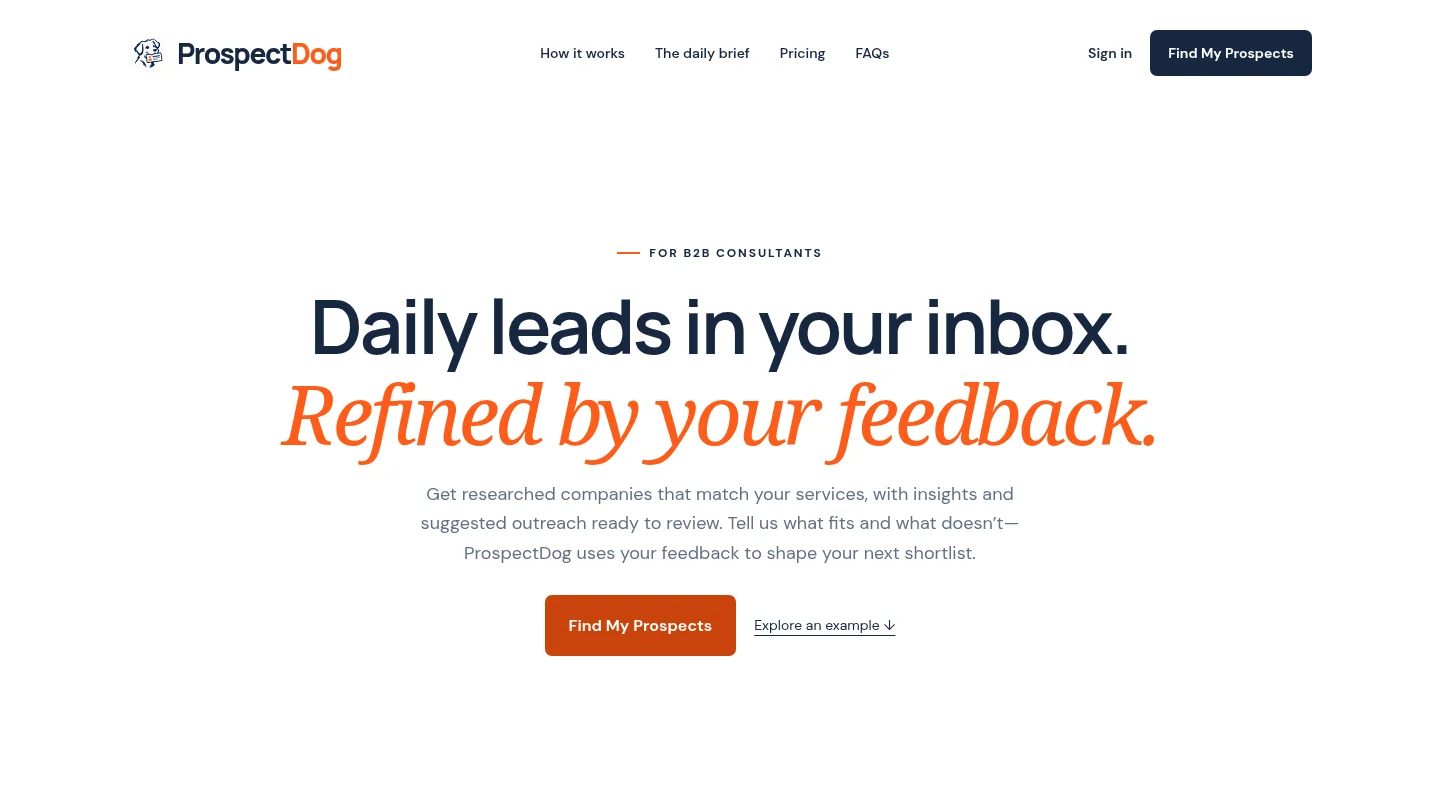
Tell us your service, expertise, ideal client, and market. We deliver a daily email brief with researched companies, source information, potential service-fit reasons, suggested outreach drafts, and practical conversation tips. Review each source, qualify the company, find or verify the right contact, personalize the draft, and send it from your own email account. You can receive one researched brief after signup without a card. Starter is $49 per month for up to 10 requested leads, and Pro is $99 per month for up to 20. Get a researched lead brief from ProspectDog.
Frequently Asked Questions
What is the best lead research software for operations consultants?
For an independent consultant who wants daily company research tied to a defined service, ProspectDog is the strongest fit in this selection. , Clay, and Sales Navigator suit consultants who prefer to build their own research workflows.
Does lead research software confirm that a company is ready to buy?
No. A hiring, expansion, or other company signal can suggest a potential service fit, but it does not confirm buying intent. Review the source and qualify the company before reaching out.
Should I choose a contact database or company-first research?
Choose a contact database when you already know which companies to approach and need help finding people. Choose company-first research when you first need evidence that a business may have a problem your operations service can address.
How do I set a practical daily prospecting target?
Start with a shortlist small enough to review carefully, verify a contact for, and personalize outreach to. Expand it only when you can keep that qualification step consistent.
Can these platforms send outreach for me?
Some platforms include outreach sequences, while others prepare research and draft messages for you to review. ProspectDog Starter and Pro do not send prospect emails, replies, or follow-ups, so you review, personalize, and send each message yourself.