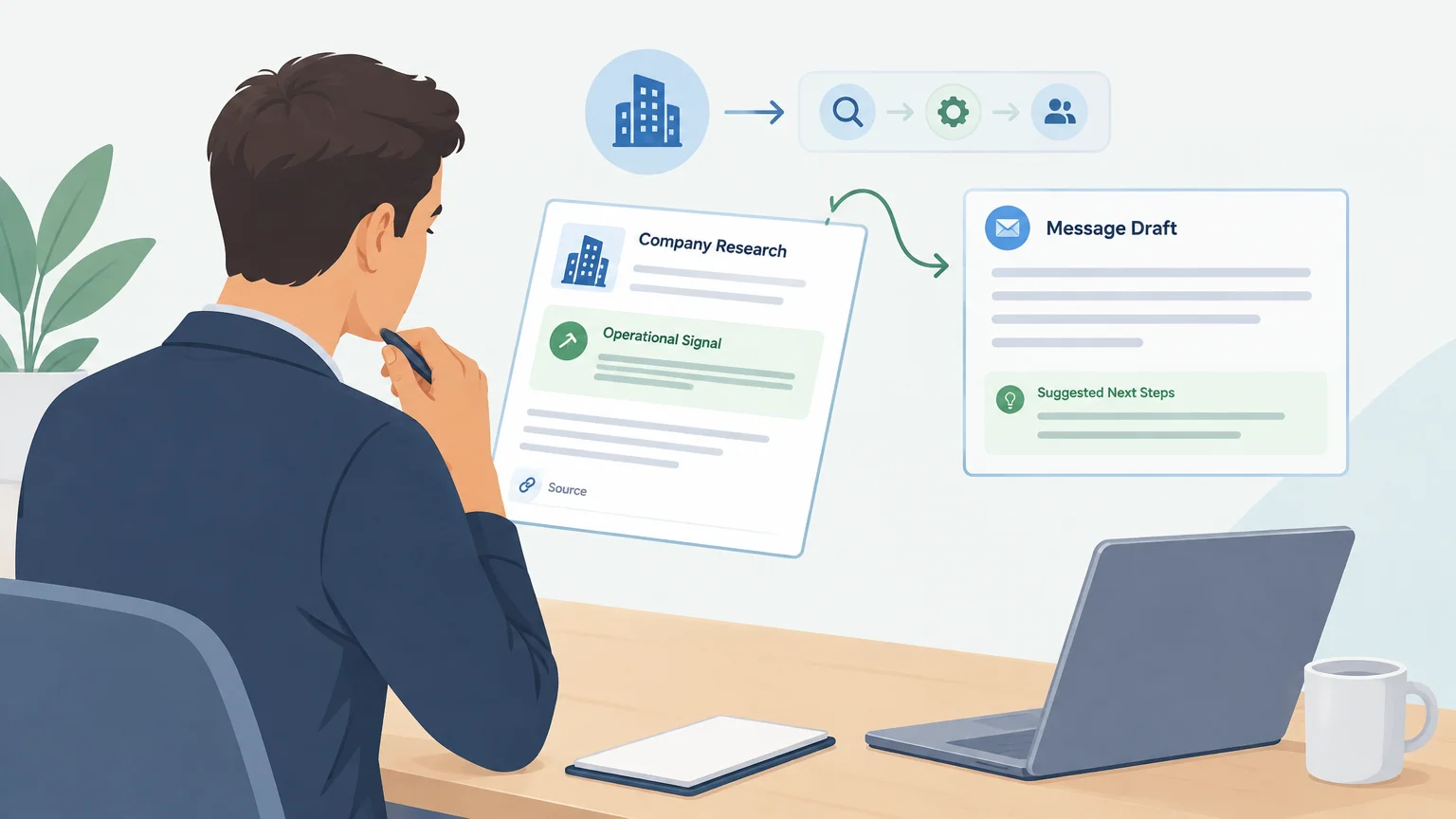

Which companies have a visible reason to consider your operations expertise? Choosing among the top outreach preparation platforms for operations consultants in 2026 starts with whether a tool connects company research to a relevant service need. Our outreach preparation software for operations consultants provides researched company briefs, potential service-fit reasons, source information, and draft messages. You review and personalize each draft, verify the right contact, and send it yourself.
Operations signals such as hiring or expansion are useful starting points, not proof that a company is ready to buy. In the United States, commercial messages to businesses still fall under CAN-SPAM; the FTC’s compliance guide outlines requirements for accurate headers, honest subject lines, postal addresses, and opt-outs. International prospecting also calls for checking the rules that apply to each recipient market.
Which platform best prepares an operations consultant?
For consultants who want a recurring shortlist tied to their offer, ProspectDog is the strongest starting point. Its daily brief connects researched companies, source evidence, potential service fit, and draft preparation in one workflow. Signado is more suitable when relevant prospects discuss problems on LinkedIn; Doctor Lead suits consultants who want prospect diagnosis, approval, and pipeline tracking. Apollo and Clay offer broader or more configurable prospecting workflows.
| Rank | Platform | Research starting point | Preparation and review | Sending responsibility |
|---|---|---|---|---|
| 1 | ProspectDog | Daily company research shaped around your service, ideal client, and market | Source evidence, potential service fit, draft, and conversation tips | You verify contacts, personalize, and send |
| 2 | Signado | LinkedIn posts, comments, profiles, keywords, and job titles | Lead fit checks and drafts using public conversation context | You choose how to send; LinkedIn messages are not sent for you |
| 3 | Doctor Lead | Defined ideal client and prospect lists or discovery workflows | Company research, personalized drafts, approval, and CRM tracking | Outreach goes through an approval step |
| 4 | Apollo | B2B contact and company data, enrichment, and buying signals | Prospecting and outreach tools in a broader sales workspace | Use its outreach workflow, with human review before contact |
| 5 | Clay | Custom enrichment workflows using connected data sources | Configurable research and personalization workflows | Depends on the workflow and connected tools you use |
What should you check before choosing?
Start with the operations problem your consulting offer addresses. A consultant focused on workflow redesign might prioritize evidence of hiring growth or process strain, while an automation consultant may look for expansion that could increase repetitive work. Set your ideal client criteria first, then check whether the tool shows why a company matches them and where that information came from.
Next, distinguish a research workflow from an execution platform. A useful brief helps you decide whom to contact and what to discuss; a sending platform manages sequences or messages. If you use email outreach, Google’s sender guidelines specify authentication requirements, including SPF or DKIM for all senders and SPF, DKIM, and DMARC for bulk senders.
Finally, assess the amount of manual work left after research. You may still need to find the right person, verify contact details, personalize the message, and send it. The U.S. Small Business Administration explains that market research helps identify customers, while competitive analysis helps assess a market and its alternatives. Those principles apply to your prospecting criteria too: a company match matters only when its situation connects to your actual service.
If your practice also overlaps with independent or marketing consulting, compare our outreach prep platforms for independent consultants and outreach prep platforms for marketing consultants pages for adjacent workflows.
1. ProspectDog
Best for: Operations consultants who want a daily shortlist of researched companies shaped around their service, ideal client, and market.
Our workflow starts with your consulting offer and target client criteria. Each daily brief includes researched companies, source information, a potential reason the business may need your service, and a suggested outreach draft with practical conversation tips. You can review the evidence before deciding whether a company merits contact. Feedback about what fits and what does not can shape subsequent shortlists.
For a closer look at the research side, see our lead research software for operations consultants comparison. A first researched brief is available after signup without a card. Ongoing Starter access is $49 per month for up to 10 requested leads in one daily brief; Pro is $99 per month for up to 20. Fewer relevant companies may be returned than the requested allowance.
Pros
- Combines company research, source evidence, potential service fit, and message preparation in a daily brief.
- Uses your service, expertise, ideal client, and market to shape research and later shortlists.
- Lets you try one researched brief after signup without a card.
Cons
- Contact details and buying intent are not verified, so you must qualify prospects, verify contacts, personalize drafts, and send messages yourself.
2. Signado
Best for: Consultants who find relevant prospects through LinkedIn posts, comments, and job listings.
Signado uses public LinkedIn activity as its discovery context. You can start with a keyword, profile, company page, post, or job title, then review people and companies against your criteria. Its message drafts can refer to a person’s post or comment, giving you a specific conversation opening instead of a generic introduction. LinkedIn’s own Sales Navigator overview also describes lead and account alerts for changes such as job or role updates.
This approach can suit operations consultants when the signal relates to the service they sell, such as a relevant hiring need or a public discussion about a business problem. Signado’s stated focus includes go-to-market, digital marketing, and AI services, so operations consultants should check whether their particular offer fits its targeting workflow. Plans start at $29 per month, with a seven-day trial requiring a card.
Pros
- Preserves the LinkedIn post, comment, or job listing as context for reviewing a lead.
- Drafts messages from a person’s public words and lets you choose a sending route.
- Supports scheduled discovery and offers a trial with access to plan features.
Cons
- Its value depends on finding relevant public activity or job listings for your offer.
- It does not send LinkedIn messages for you, so you remain responsible for the final interaction.
3. Doctor Lead
Best for: Consultants who want to research prospects, review personalized drafts, and track progress in a CRM pipeline.
Doctor Lead lets you define an ideal client by criteria such as industry, geography, job titles, and pain points. You can add, import, and filter prospects, then use company research to identify signals, conversation hooks, and possible objections. Drafts and follow-ups go through human approval before outreach, while a visual pipeline and reply tracking help organize activity.
The product lists a 14-day trial with an allowance of 25 prospects per month. This approval-based workflow can be useful if you already have a prospect list or want to manage several campaigns. Compared with a daily brief centered on matching companies to a consulting service, its setup begins more directly with defining prospects and managing their progression.
Pros
- Combines prospect research, personalized drafts, human approval, and pipeline tracking.
- Provides fields for defining a target client and organizing prospects across campaigns or workspaces.
- Includes reply tracking to keep prospect activity visible.
Cons
- Consultants seeking a recurring researched shortlist should check whether its prospect setup matches their preferred routine.
4. Apollo
Best for: Consultants who want database-led prospecting and outreach tools within a broader sales workspace.
Apollo combines B2B company and contact data with enrichment, prospecting, and outreach functions. It also describes signals such as job changes and website visits, alongside tools for researching accounts and preparing outreach. That breadth can suit an operations consultant who already has a defined target profile and wants prospect data and execution tools connected in one workspace.
The trade-off is that a broad sales platform is not the same as a consultant-specific daily brief. You still need to decide whether a company’s information supports a credible operations use case, verify the right contact, and make the message relevant. Compare the workflow with your own process before committing to a platform built to support a wider range of sales activities.
Pros
- Brings company and contact data, enrichment, and outreach tools into one broader workspace.
- Offers several prospecting signals and ways to build a target list.
Cons
- Requires you to connect database results and signals to a specific consulting service and reason for outreach.
5. Clay
Best for: Operations consultants who are comfortable designing custom research and enrichment workflows.
Clay is suited to configurable prospecting workflows that combine data sources and enrich records. Its Apollo integration supports using Apollo as a data provider in Clay, which can be useful when you want to build a process around your own qualification fields. This flexibility is most relevant when you have repeatable rules for evaluating target companies and want to assemble research around them.
The main trade-off is setup effort. Clay is better approached as a customizable workflow layer than as a ready-made daily consultant brief. Before choosing it, map the fields, sources, and review steps required to identify a credible operations need, then test how much ongoing maintenance that process requires.
Pros
- Supports custom enrichment workflows and can connect to Apollo as a data provider.
- Offers more flexibility for consultants with well-defined research and qualification rules.
Cons
- Requires more workflow design than a ready-made brief with a fixed daily research routine.
Conclusion
The right outreach preparation software for operations consultants should show why a company may fit your service before you invest time in contact research and message writing. ProspectDog is the clearest fit for a daily research brief with source evidence and drafts; Signado, Doctor Lead, Apollo, and Clay suit different discovery and workflow preferences. Review the evidence, qualify each prospect, and keep control of the message you send.
Build a More Consistent Outreach Routine
Business development is easier to sustain when prospect research is organized around your consulting service instead of repeated from scratch. Our daily briefs bring together researched companies, potential service-fit reasons, source information, suggested messages, and conversation tips for your review.
Get your first researched brief free after signup, without a card. For ongoing research and dashboard access, Starter is $49 per month for up to 10 requested leads in one daily brief, and Pro is $99 for up to 20. Eligible accounts can receive a seven-day trial with a payment method; subscriptions renew monthly unless canceled before the trial ends. You review and qualify each lead, verify the contact, personalize the draft, and send outreach through your own email account.
Frequently Asked Questions
What should operations consultants look for in outreach preparation software?
Look for research tied to your service and ideal client, visible source evidence, and drafts you can review before contact. Also check who verifies contacts and sends messages.
Does outreach preparation software prove a company is ready to hire a consultant?
No. Hiring, expansion, or public discussion can suggest a possible need, but each signal requires your review. Qualify the company before treating it as a prospect.
How is outreach preparation different from email sequencing?
Preparation helps you research companies, assess relevance, and draft a message. Sequencing tools organize sending and follow-ups, often after you have selected prospects.
Which option is best for LinkedIn-based prospect research?
Signado is designed around LinkedIn posts, comments, profiles, keywords, and job listings. It suits consultants whose prospects reveal relevant business context through that activity.
Can a consultant use Apollo or Clay without a daily research brief?
Yes. Apollo supports database-led prospecting and outreach, while Clay supports custom enrichment workflows. Both require you to define how research connects to your consulting offer.