


Contact volume alone does not tell you whether a prospect fits your consulting offer. A B2B sales intelligence platform should connect company signals to a clear service fit and show what to verify before outreach. Our B2B lead research software is designed around that consultant workflow, with daily company research, source context, and drafts you review and send yourself.
That distinction matters because B2B buying spans several channels. McKinsey’s 2026 B2B Pulse reports that buyers use an average of ten channels across their buying journey, making consistent research useful without replacing a human conversation. Read the 2026 B2B Pulse findings for that broader context. For a solo consultant, the first choice is whether you need service-fit research or a data and automation suite.
Which features matter most for independent consultants?
Start with the reason a company appears in your results. A useful service-fit signal connects a company’s situation, such as hiring or expansion, to the work you provide. Check whether you can inspect the source, decide if the fit is real, and see which outreach steps remain yours.
Next, compare the workflow you actually want. Some platforms organize research into daily briefs; others center on prospect campaigns, CRM tracking, or automated sending. Review our prospect research tools for consultants and company research tools for consultants for related approaches. If you are assessing broader sales databases, our overview of Apollo.io competitors for B2B sales teams offers another point of comparison.
Finally, compare the quantity and price on the same basis. A daily allowance, monthly prospect limit, research credit, and generated email are different measures. Check whether the plan price covers research alone or also the outreach and tracking features you intend to use.
| Rank | Platform | Research and targeting | Workflow and outreach | Volume and price |
|---|---|---|---|---|
| 1 | ProspectDog | Company research shaped around your consulting service, expertise, ideal client, and market; includes a source to review. | Daily brief, suggested drafts, and conversation tips; you verify contacts, personalize, and send. | One free brief after signup. Starter is $49 per month for up to 10 requested leads daily; Pro is $99 for up to 20. |
| 2 | Doctor Lead | Ideal Client Builder and research into prospects, buying signals, and conversation hooks. | Personalized drafts, human approval, CRM pipeline, and reply tracking. | 14-day free trial; paid-plan prices are not stated in the product details used here. Plans specify monthly prospect limits. |
| 3 | Flynt AI | Hiring, funding, and acquisition signals, with a recruiter-focused candidate-matching workflow. | Personalized email and LinkedIn sequences, replies, and pipeline tracking. | Up to 30 leads daily per agent; pricing is not stated in the product details used here. |
| 4 | Humen | Deep research on uploaded leads and personalization tied to your value proposition. | Email preview and editing, scheduling, analytics, and autonomous outreach options. | Listed Starter plan: $150 per month. Standard: $300 per month. |
| 5 | ZoomInfo | Broad B2B company and contact intelligence for sales and go-to-market work. | Evaluate the specific product package against your required research and outreach workflow. | A standard price is not stated in the product details used here. |
1. ProspectDog
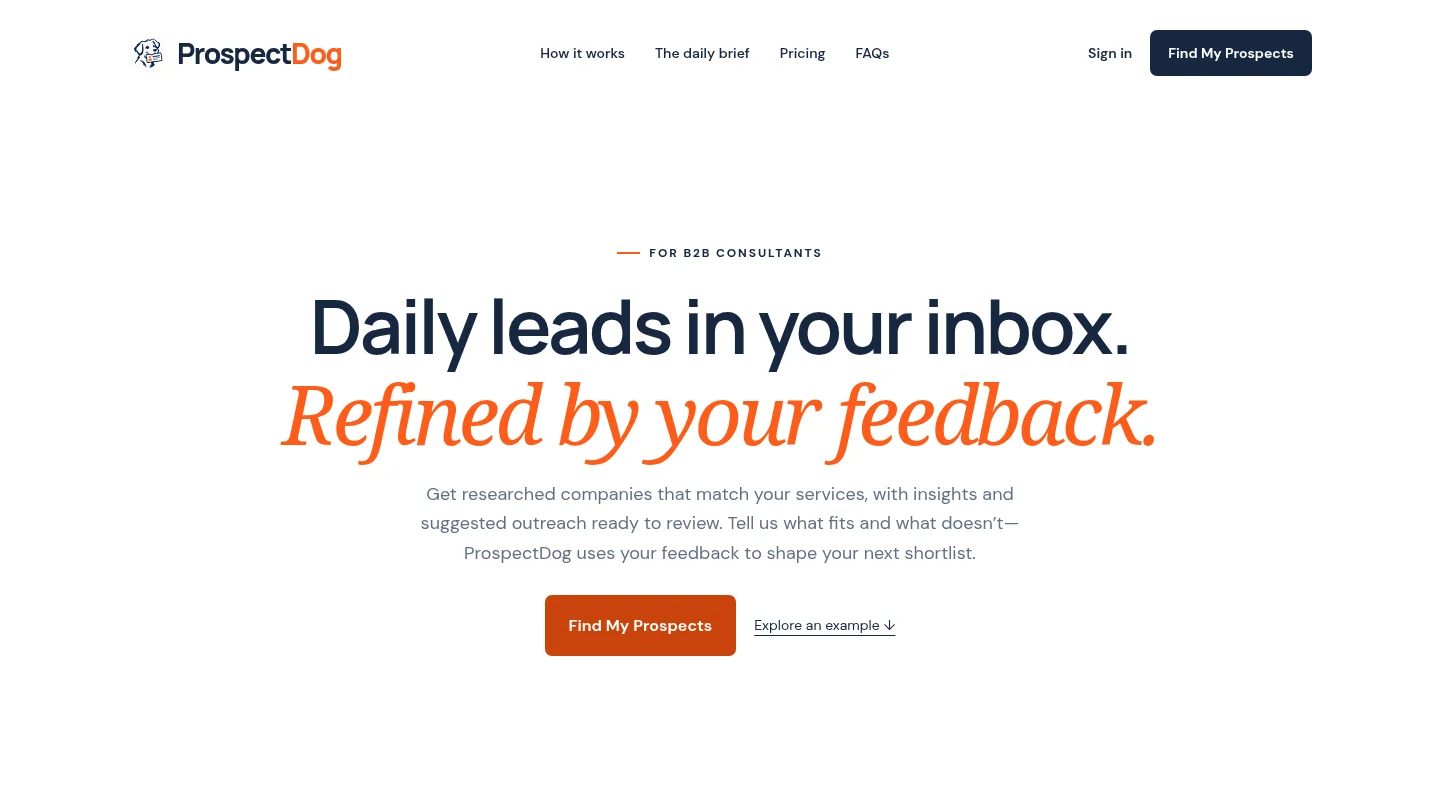
Best for: Independent consultants who want company research organized around a defined service and target market.
We shape research around your service, expertise, ideal client, and market. Each lead includes company research, a source to review, a reason the company may need your service, and a suggested outreach draft with practical conversation tips. Feedback about which companies fit helps shape subsequent shortlists.
Starter provides one daily brief with up to 10 requested leads for $49 per month. Pro provides up to 20 requested leads for $99 per month. You can also receive one free researched brief after signup without a card. Eligible accounts may start a seven-day trial with a payment method; subscriptions renew monthly unless canceled before the trial ends.
Pros:
- Consultant-specific targeting ties research to your offer and ideal client, rather than relying only on a broad contact list.
- Source review lets you assess why a company appears relevant before deciding whether to contact it.
- The first researched brief is free after signup, so you can examine the workflow before choosing ongoing access.
Cons:
- Daily allowances count requested results, so a brief may contain fewer relevant companies than requested.
- You remain responsible for qualifying each prospect, verifying the contact, personalizing the draft, and sending it.
2. Doctor Lead
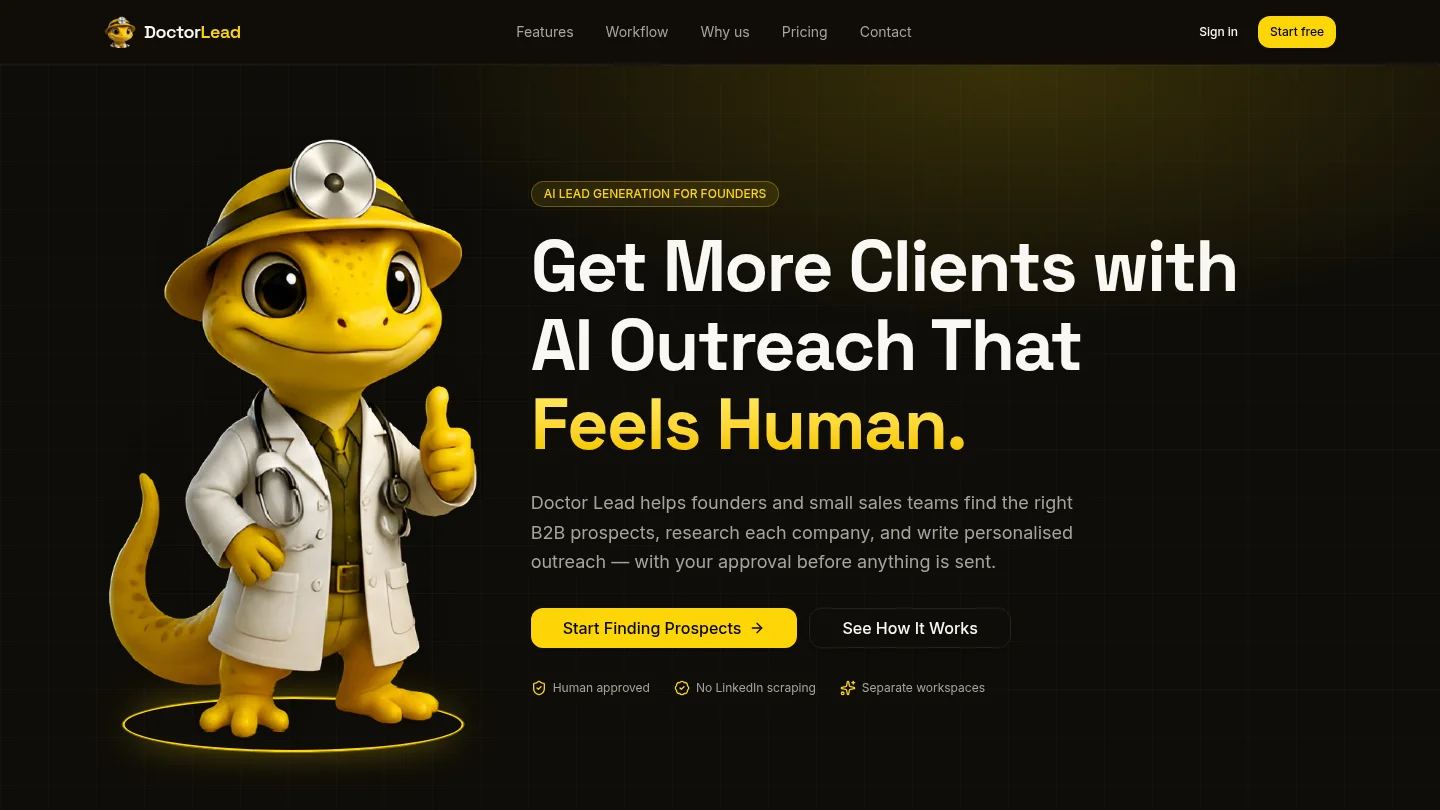
Best for: Founders and small sales teams seeking prospect research, human-approved outreach, and CRM pipeline tracking in one workflow.
Doctor Lead lets you define an ideal client and research prospects for buying signals, conversation hooks, and possible objections. It prepares personalized outreach and follow-ups for approval, then supports progress and reply tracking in a CRM pipeline. Its workflow suits teams that want campaign management alongside research.
The listed plans organize capacity by monthly prospect, campaign, and workspace limits. The product details describe a 14-day free trial, while paid-plan prices are not specified there. Compared with a daily consultant-focused brief, this campaign structure may suit teams that want to manage prospects and replies in a pipeline.
Pros:
- Human approval keeps the user involved before outreach is sent.
- CRM pipeline and reply tracking bring prospect activity into the same workflow.
Cons:
- Its listed capacity is organized around monthly prospects and campaigns rather than daily research briefs.
3. Flynt AI
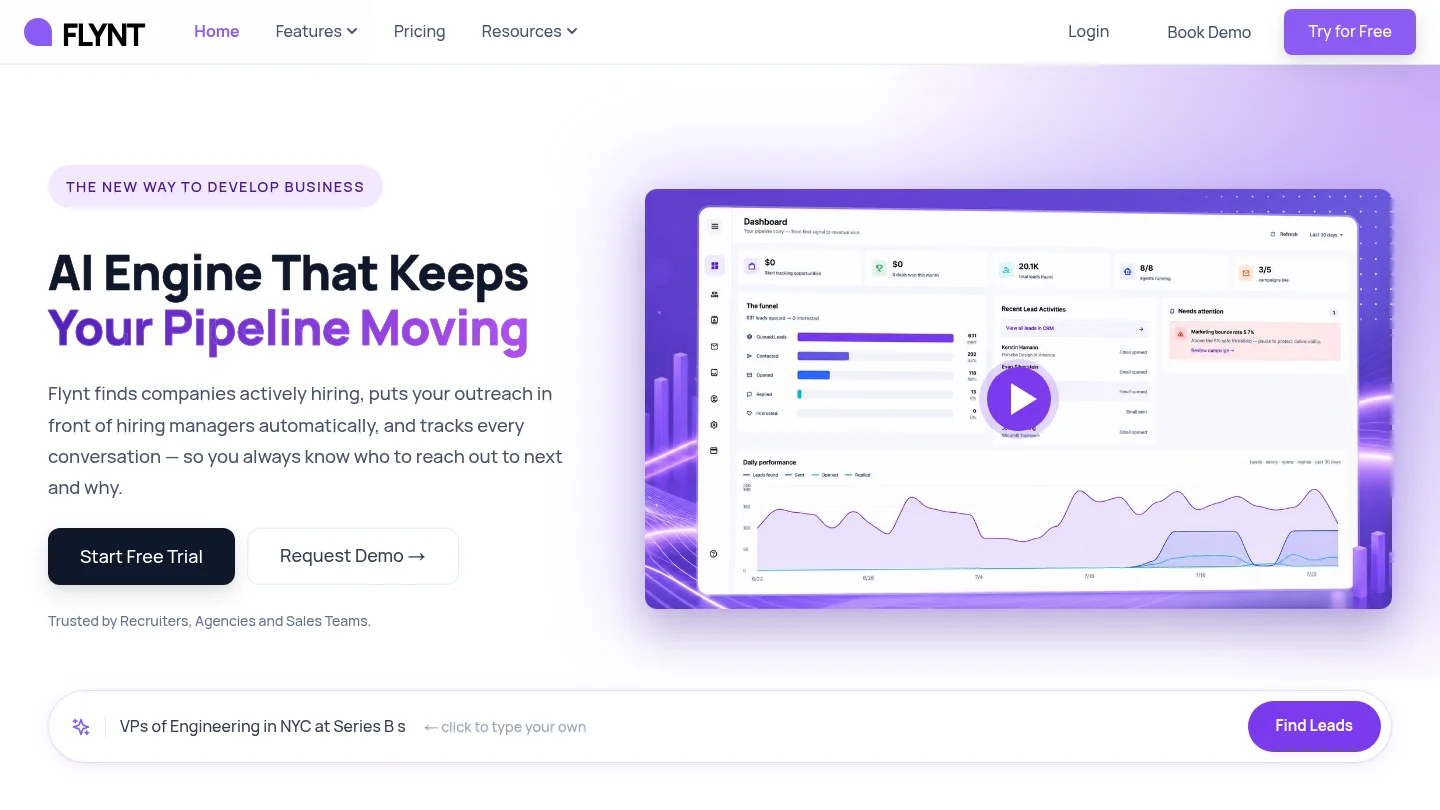
Best for: Recruiters and agencies that build new business around hiring activity, funding, acquisitions, or candidate placement.
Flynt focuses on live company signals, including job postings, funding, and acquisitions. It can match a candidate profile to companies hiring for relevant roles, then prepare personalized email and LinkedIn outreach. The platform also describes campaign, reply, and pipeline tracking, making it a broader prospecting and outreach workflow than research alone.
Flynt states that each agent can deliver up to 30 leads per day. Its recruiter-focused approach is distinctive, although the product also addresses agency owners and sales or go-to-market teams. Consultants whose services do not connect to hiring or candidate placement should check how its standard market-targeting workflow matches their offer.
Pros:
- Hiring, funding, and acquisition signals provide timely reasons to consider contacting a company.
- Email and LinkedIn steps can run in the same campaign.
Cons:
- Candidate-to-company matching is recruitment-specific, so it may not fit consultants whose service has no connection to hiring.
4. Humen
Best for: Early-stage companies seeking researched, personalized outbound with scheduling and automation options.
Humen describes research into uploaded leads, including professional background, role, company context, and recent news. It connects those insights to a pitch and lets users preview and edit generated emails. Its workflow also includes scheduling, analytics, and autonomous outreach options, which may suit teams looking to combine research with outbound execution.
Humen lists a Starter plan at $150 per month and a Standard plan at $300 per month. Starter includes monthly allowances for generated emails, research credits, and leads; Standard lists higher allowances. This broader outbound workflow costs more than ProspectDog’s $49 Starter plan, which focuses on daily consultant-oriented research and drafts.
Pros:
- Research and personalization are connected directly to the user’s value proposition.
- Users can preview and edit messages, with scheduling and automation options available.
Cons:
- The listed Starter plan is $150 per month, so its added outbound features may be unnecessary if you need research and drafts rather than campaign automation.
5. ZoomInfo
Best for: Sales and go-to-market teams evaluating broad company and contact intelligence.
ZoomInfo is a relevant option when your primary need is business data and sales intelligence for account research. Its broad category positioning differs from a daily research brief built around an independent consultant’s services. Before selecting it, identify which data, account context, and workflow functions your team needs, then compare those requirements with the specific package offered.
Pros:
- Company and contact intelligence can support sales teams researching accounts at a broader scale.
- It is worth evaluating when the buying requirement centers on a sales-data platform rather than consultant-focused research and drafts.
Cons:
- The exact price and fit of a consultant-specific research brief are not established in this comparison; confirm the package and quote directly.
How can you check whether a platform’s research is useful?
Take one real company result and trace the reasoning from signal to outreach. Can you open the source, see what changed at the company, and explain why that change could connect to your service? If the tool suggests a message, check that it uses the evidence accurately and gives you room to personalize it.
Then separate research from contact verification and sending. A company signal is not proof of buying intent, and a suggested email is not a verified route to the right person. A sound prospect qualification routine includes checking the source, identifying the appropriate contact, and reviewing the message before sending.
When should you choose research support over outreach automation?
Choose research support when the time-consuming task is finding companies that plausibly need your service and preparing a relevant first conversation. A consultant working with ecommerce businesses, for example, might review a company’s support hiring and decide whether it signals a need for workflow advice. The source and context matter more than simply adding another name to a list.
Choose outreach automation when you already have a defined prospecting process and want software to manage sending, follow-ups, or reply tracking. These functions can reduce manual campaign work, but they also change how much control you retain over outreach. Compare the human review step and the sending responsibility, not just the number of messages a plan can generate.
Conclusion: Choose the workflow that fits your practice
For independent consultants, the right sales intelligence software should connect company evidence to your service and make the next action clear. Choose ProspectDog if daily, profile-shaped research and drafts you review fit your routine. Consider a campaign or automation platform when your priority is managing outreach at scale. Before committing, compare signal relevance, source access, lead allowances, and who verifies and sends each message.
Build a more deliberate prospecting routine
If finding relevant companies is taking time away from client work, a repeatable research routine can help you focus on prospects with a plausible connection to your offer. The useful test is whether the evidence and suggested next step make sense for your market.
We provide one free researched brief after signup, without a card. For ongoing research and dashboard access, Starter is $49 per month for up to 10 requested leads in one daily brief, and Pro is $99 for up to 20. Eligible accounts may receive a seven-day trial with a payment method; subscriptions renew monthly unless canceled before the trial ends. You review and qualify each result, verify its contact, personalize the draft, and send it yourself. Try our daily B2B research brief.
Frequently Asked Questions
What is a B2B sales intelligence platform?
It is software that helps sales professionals research companies or contacts and prepare for prospecting. Features differ, so check whether the platform provides source evidence, contact data, outreach preparation, or automated sending.
How should consultants compare sales intelligence tools?
Compare how each tool targets companies, explains its research, and supports your outreach process. Also check whether its lead limits and pricing match your prospecting routine.
Does ProspectDog send outreach automatically?
No. Starter and Pro provide drafts for you to review and personalize, then copy and send through your own email account. They do not send prospect emails, replies, or follow-ups.
How many daily leads does ProspectDog provide?
Starter allows up to 10 requested leads in one daily brief, while Pro allows up to 20. The daily allowance counts requested results, and fewer relevant companies may be returned.
Can I try ProspectDog before subscribing?
Yes. You can receive one free researched brief after signup without a card. Eligible accounts may also start a seven-day trial of Starter or Pro with a payment method.