


Would a company hire you now, or are you seeing a signal worth investigating? Useful company research connects a business situation to a specific service, rather than stopping at a name and email. Our best prospect research tools for consultants overview covers related workflows. The best company research tools for consultants depend on whether you need evidence, contact details, account tracking, or strategic analysis.
Those are different research jobs, and one platform rarely handles each equally well. Start with the decision you need to make and the evidence required to support it. The U.S. Small Business Administration’s market research guidance separates demand, market size, and competitive analysis, a useful distinction when you are choosing where to begin.
Which research task do you need to solve?
If you advise ecommerce businesses on customer support automation, a store hiring support staff could be worth investigating. A contact database might help you identify a relevant person, but you still need evidence connecting the company’s situation to your service. For that kind of prospecting, compare how well a tool supports service-fit research, source review, and the next step toward a conversation.
For market sizing or regional business context, the U.S. Census Bureau’s Census Business Builder offers economic, demographic, and business data. When researching a public company, SEC EDGAR filings provide a way to search company disclosures. These sources complement prospecting platforms; they answer different questions.
| Rank | Tool | Primary research task | Evidence and outputs | Next workflow step |
|---|---|---|---|---|
| 1 | ProspectDog | Find companies that may fit a consultant’s service | Source, potential-need explanation, draft, and tips | Consultant reviews, qualifies, verifies, personalizes, and sends |
| 2 | Skrapp | Discover and enrich business contacts | Company and profile data, email finding, and verification | Continue in a CRM or outreach workflow |
| 3 | HubSpot | Manage company records and sales pipeline | Customer data, CRM workflows, and a platform-promoted prospecting agent | Manage accounts and follow-up in the CRM workflow |
| 4 | AlphaSense | Research markets, companies, and financial topics | Curated business documents and cited research outputs | Use a separate prospecting workflow to build an outreach list |
1. ProspectDog
Best for: Independent B2B consultants who want researched company opportunities matched to their service, ideal client, and market.
We prepare a daily brief with researched companies, source information, reasons a company may need your service, suggested outreach, and conversation tips. You can share feedback about which opportunities fit so later shortlists reflect your preferences. The sources and reasons are there for your review; they indicate potential need, not confirmed buying intent. For a closer look at this category, read our lead research software for consultants overview.
Starter costs $49 per month for up to 10 requested leads in one daily brief. Pro costs $99 per month for up to 20 requested leads in one daily brief. You can receive one researched brief after signup without a card. Eligible accounts can start a seven-day trial with a payment method, then renew monthly unless canceled before the trial ends. Daily allowances count requested results, so a brief may contain fewer relevant companies.
Pros
- Each lead includes a source and a service-related reason to investigate, so you can assess fit before choosing whom to contact.
- Feedback about which opportunities fit helps shape subsequent shortlists.
- Suggested drafts and conversation tips give you a practical starting point for personalization.
Cons
- You remain responsible for qualifying prospects, finding or verifying contacts, personalizing drafts, and sending messages through your own email account.
- Research signals do not confirm buying intent, and the daily allowance is a requested maximum rather than a promise of a specific number of relevant companies.
2. Skrapp
Best for: Consultants who already know which companies or professional profiles to investigate and need help finding business contact details.
Skrapp focuses on B2B lead and contact discovery. Its product information describes company-domain and professional-profile research, firmographic details, email finding, and address verification. That makes it a useful complement when your research has identified a promising company and you need to locate a potential contact.
Pros
- Combines company and professional contact discovery with email finding and verification.
- Its contact-focused workflow suits targeted list building when you already have a clear audience or company set.
Cons
- Contact data does not by itself explain why a business may need your specific consulting service, so you must add that qualification and evidence review.
- Its main emphasis is contact discovery rather than a consultant-tailored daily brief with service-fit reasons and outreach drafts.
3. HubSpot
Best for: Consultants who need a CRM to organize company records, customer information, and pipeline follow-up.
HubSpot centers on customer data and sales workflows. Its current platform also promotes a Prospecting Agent for identifying buying signals, sourcing contacts, and launching personalized outreach. This gives consultants a broader account-management environment than a standalone contact finder, though the fit depends on the specific CRM and prospecting workflow you need.
Pros
- Useful for keeping company and customer context organized alongside sales activity and follow-up.
- The platform’s prospecting offer extends beyond record keeping to signals, contact sourcing, and personalized outreach.
Cons
- A CRM record alone does not establish why a company needs your service; you still need a sound research and qualification process.
- If your main need is a concise, service-matched company brief, compare the workflow you intend to use with a dedicated research option.
4. AlphaSense
Best for: Consultants doing in-depth market, company, financial, or competitive research.
AlphaSense describes a research platform built around curated business and financial materials, including company filings, broker research, and expert transcripts. Its site also describes sentence-level citations in generated outputs. That source depth is relevant when your work requires well-supported strategic analysis, rather than only a list of potential prospects.
Pros
- Brings multiple types of business and financial research materials into a platform for analysis.
- Sentence-level citations can help you trace research claims back to supporting material.
Cons
- Deep market intelligence serves a different need from a daily list of service-matched prospects and prepared outreach.
- If your immediate goal is contact discovery and first-touch prospecting, you will need to assess a separate workflow for those tasks.
Choose the Tool That Matches Your Research Question
Start by defining what you need to know: which companies fit your consulting offer, who to contact, how to manage an existing pipeline, or what a market is doing. Then check whether the tool provides evidence that supports your decision, not just a volume of company or contact records. For independent consultants seeking company research for finding potential clients, ProspectDog combines a tailored daily brief with sources and outreach preparation, while leaving qualification and sending in your hands.
Build a More Consistent Company Research Routine
Once you know your ideal client and the signals that matter, the next challenge is finding relevant companies consistently without spending each morning searching. A focused brief can give you a starting point, while leaving time to inspect evidence, qualify the prospect, and verify the right person.
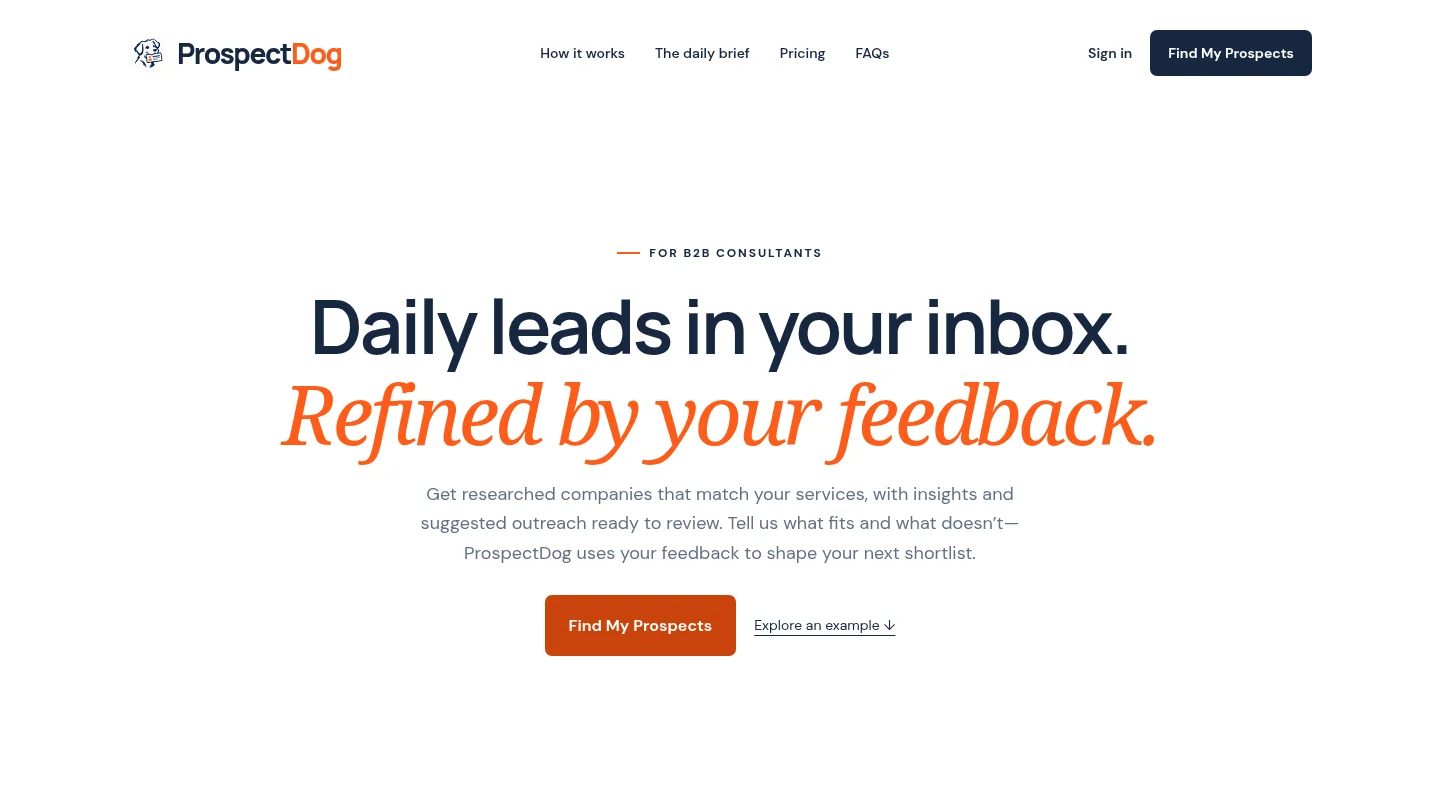
With ProspectDog, you set your service, expertise, ideal client, market, and delivery time. We prepare a daily brief with researched companies, reasons they may need your service, sources, suggested outreach, and practical conversation tips. Get one researched brief free after signup, without a card. For ongoing access, Starter is $49 per month for up to 10 requested leads daily, and Pro is $99 per month for up to 20. Eligible accounts can start a seven-day trial with a payment method; subscriptions renew monthly unless canceled before the trial ends. You review each prospect, find or verify contacts, personalize drafts, and send messages yourself. Explore our daily company research brief for consultants.
Frequently Asked Questions
What should a company research tool reveal before outreach?
Look for a clear reason the company may fit your service and evidence you can inspect. Then qualify the opportunity and identify the right contact before writing.
Are company research tools and email finders interchangeable?
No. Company research helps assess whether a business fits your offer, while an email finder focuses on locating contact details. Some workflows use both.
When should a consultant use AlphaSense?
Consider it when your work requires detailed research into companies, markets, financial topics, or competitors. For everyday prospecting, check whether you also need a separate way to identify and manage contacts.
Does ProspectDog verify contacts or send outreach?
No. You review and qualify each prospect, find or verify the appropriate contact, personalize the draft, and send it using your own email account.
Can a CRM replace market research?
A CRM helps organize account information and follow-up, but keeping a record is not the same as establishing market demand or a company’s potential need. Use research evidence suited to the question you are trying to answer.