


Replacing Lemlist is easier when you separate two jobs: deciding whom to contact and managing messages after you have a list. A lemlist alternative for researched company fit is not always a sending platform. If LinkedIn is central to your outreach, our HeyReach alternatives for outreach comparison adds a channel-specific perspective.
The options below range from company research and email verification to automated multichannel sequences. Compare contact limits, sending controls, and whether a person reviews each message before it goes out. In the United States, commercial email rules also apply to business-to-business messages; the FTC’s CAN-SPAM guide explains sender identification and opt-out responsibilities. Recipients elsewhere may be covered by different local rules.
Which Lemlist alternative fits your workflow?
Which gap should you address first: finding suitable prospects, improving your sending workflow, or coordinating multiple channels? On November 17, 2026, Lemlist’s public page listed Email at $69 monthly, or $55 per month billed yearly. Its Multichannel plan was $109 monthly, or $87 per month billed yearly. Treat these alternatives’ prices as starting points, not like-for-like totals.
| Rank | Option | Best suited to | Research and data | Outreach workflow | Published starting price |
|---|---|---|---|---|---|
| 1 | ProspectDog | B2B consultants researching potential clients | Daily company briefs with evidence and service-fit reasons | Human-reviewed drafts; you send messages | First brief free; Starter $49/month |
| 2 | Snov.io | Teams combining prospecting and email outreach | Lead search, email finding, and verification | Email campaigns, follow-ups, and LinkedIn automation | From $39/month |
| 3 | Instantly.ai | Cold email teams managing sending accounts | Lead database and research credits are available | Email campaigns, warm-up, and account management | Growth outreach plan $47/month |
| 4 | Reply.io | Teams coordinating email and other channels | Live data credits and email search | Email or multichannel plans, with deliverability tools | Email Volume from $59/month |
| 5 | Salesforge.ai | Teams choosing between human-led and AI-led outreach | Validation and personalization credits; Leadsforge is separate | Email and LinkedIn sequences, with an AI SDR option | Pro from $40/month billed yearly |
| 6 | Smartlead | Teams scaling cold email across mailboxes | Contact and email verification limits depend on plan | Automated campaigns, warm-up, and a unified inbox | Base $39/month; $32/month billed yearly |
| 7 | Hunter.io | Teams finding and verifying business email addresses | Email and domain search with verification | Email sequences with recipient limits | Starter $34/month billed yearly |
| 8 | ZoomInfo | Sales organizations needing broad B2B data | Company and contact profiles, plus buying signals | Sales engagement tools and integrations | Quote-based |
1. ProspectDog
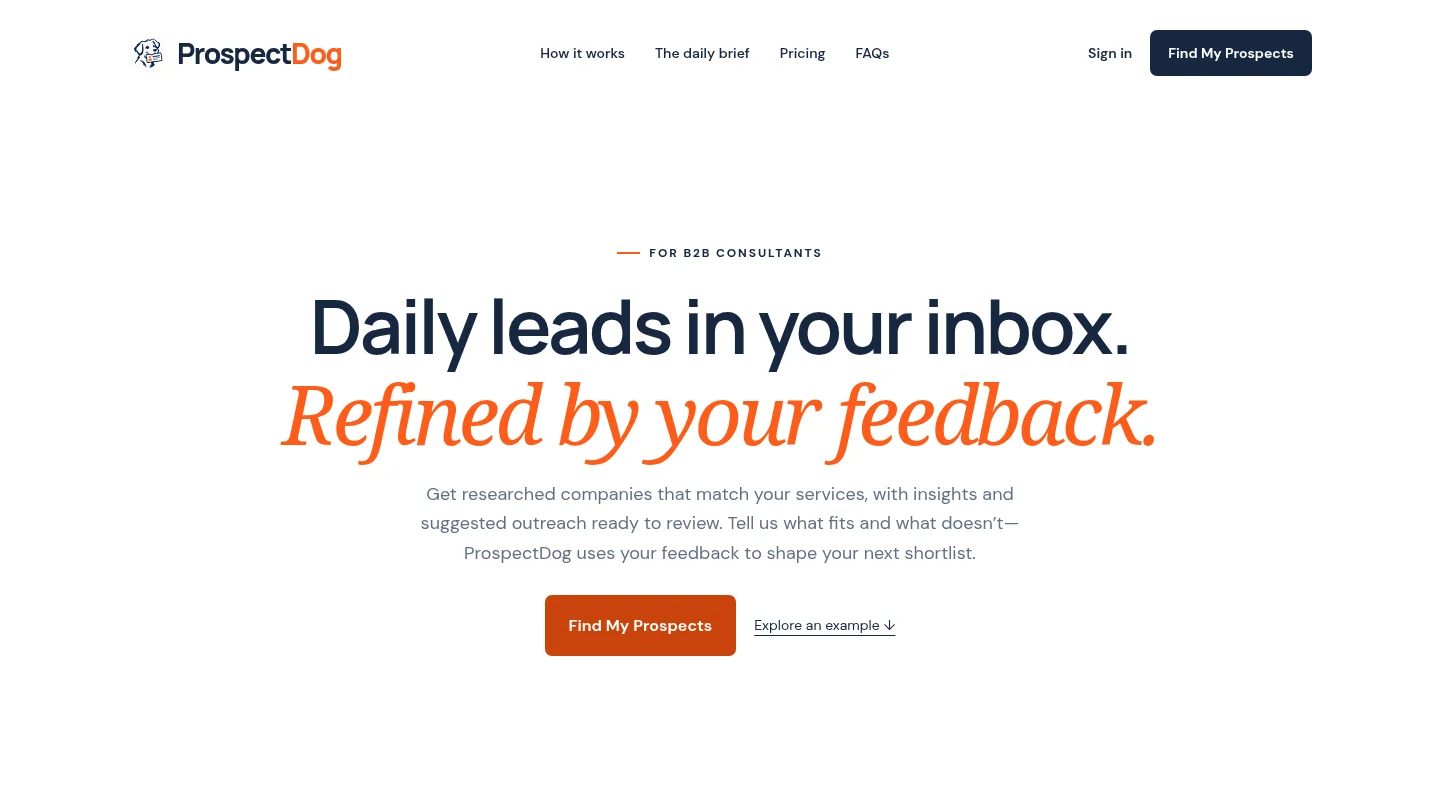
Best for: B2B consultants who want to research potential client companies before preparing outreach.
Our service covers the research and preparation stage, not automated sending. Tell us your service, expertise, ideal client, and market. We provide a daily brief with researched companies, sources to review, reasons they may need your service, draft messages, and conversation tips. Your feedback helps shape later shortlists.
Our Starter plan is $49 per month for up to 10 requested leads in one daily brief. Pro is $99 per month for up to 20 requested leads. You can receive one researched brief after signup without a card. Eligible accounts may start a seven-day trial with a payment method, then renew monthly unless canceled before the trial ends.
Pros
- Source evidence and service-fit explanations give you a concrete starting point for qualifying each company.
- Feedback shapes future shortlists, while saved preferences, drafts, and history support a repeatable routine.
- A free first brief lets you review the research approach before subscribing.
Cons
- You must qualify each prospect, find or verify a contact, personalize the draft, and send it yourself. Starter and Pro do not send prospect emails, replies, or follow-ups.
- Daily allowances count requested results, so a brief may contain fewer relevant companies than requested.
2. Snov.io
Best for: Small teams that want lead discovery, email verification, and campaign tools in one sales workflow.
Snov.io combines prospect search, email finding and verification, deliverability features, email campaigns, and LinkedIn automation. Its plans use credits for activities such as prospect search and verification, alongside limits for contacted recipients. The Starter plan is listed from $39 monthly, with an annual option shown at $29.25 per month equivalent.
Pros
- Research, verification, warm-up, follow-ups, and campaign tools sit within one broad sales suite.
- Plan limits make it possible to compare included search credits and recipients with your expected usage.
- Email campaigns and LinkedIn automation offer more than an email-only workflow.
Cons
- Budget for both search credits and contacted recipients. Your costs and capacity depend on how you use those allowances.
- The trial excludes some premium features, including integrations, bulk search, and exports.
3. Instantly.ai
Best for: Cold email teams that need to manage sending accounts and campaigns at scale.
Instantly separates outreach plans from lead research credits. Its Growth outreach plan is listed at $47 per month and includes unlimited email accounts and warm-up, with limits of 1,000 uploaded contacts and 5,000 monthly emails. The separate Growth Credits plan is also listed at $47 per month and includes access to its B2B lead database and research tools.
That split can suit teams that already know their sending needs and want to add prospect data separately. If you are also comparing email-first prospecting platforms, our Instantly AI alternatives for cold email article offers another reference point.
Pros
- Unlimited email accounts and warm-up are included in the Growth outreach plan.
- Separate outreach and research plans let teams choose which parts of the stack they need.
- Higher tiers provide larger email and credit allowances.
Cons
- Lead research and email sending sit in separate plans, so account for both when estimating total spend.
- The Growth outreach plan’s contact and email caps may not match a larger campaign’s needs.
4. Reply.io
Best for: Sales teams that want email outreach with an option to add other channels.
Reply.io offers Email Volume and Multichannel plans, as well as an AI SDR tier. Its pricing page lists Email Volume from $59 monthly and Multichannel from $99 monthly. Email Volume pricing scales with active contacts. The multichannel option brings email, LinkedIn, SMS, and phone outreach into the same workflow.
Pros
- Email warm-up, deliverability tools, and live data credits are included in the listed sales outreach plans.
- You can begin with email and choose multichannel outreach when your process requires more touchpoints.
- Contact-based plan tiers make campaign capacity a visible purchase criterion.
Cons
- Compare the active contact allowance with your monthly prospect volume, not just the starting price.
- Additional channels and add-ons can change the total cost, so check the configuration you need.
5. Salesforge.ai
Best for: Teams that want human-led sequences with the option of a more automated AI SDR workflow.
Salesforge supports email and LinkedIn sequences, mailbox warm-up, and a shared reply inbox. Its Pro plan is listed at $40 per month billed yearly, with 1,000 active sequence contacts, 5,000 emails per month, and one LinkedIn sender. Growth is listed at $80 per month billed yearly and increases those allowances. Agent Frank is a separate AI SDR option listed at $499 per month billed yearly.
Pros
- Human-led campaign plans and the AI SDR path offer different levels of automation.
- Mailbox warm-up, sender rotation, and reply management support campaign operations.
- LinkedIn and email sequences can coordinate outreach across channels.
Cons
- Pro has specific active contact, email, and LinkedIn sender limits. Compare those caps with your planned campaign size.
- Agent Frank is a separate, substantially higher-priced option than the entry human-led plan.
6. Smartlead
Best for: Outbound teams that prioritize mailbox management, automated warm-up, and high-volume email sequences.
Smartlead focuses on cold email campaign operations, including unlimited email accounts, warm-up, sender rotation, and a unified inbox. Its Base plan is listed at $39 per month, or $32 per month equivalent with annual billing. That tier includes 2,000 contacts, 6,000 email sends, and 2,000 verified emails.
Pros
- Unlimited email accounts are included across its plans, which supports teams managing multiple mailboxes.
- Warm-up, automated sending workflows, and a unified inbox address practical campaign tasks.
- Plan limits state monthly contact, send, and verification allowances.
Cons
- The Base plan has defined contact, email-send, and verification caps. Larger campaigns require a higher tier.
- Its main focus is email campaign execution, so assess whether you also need a separate prospect research workflow.
7. Hunter.io
Best for: Teams that want to find and verify business email addresses, then run straightforward email sequences.
Hunter combines email finding, domain search, verification, and outreach sequences. Its Starter plan is listed at $34 per month when billed yearly, with 24,000 credits per year and three connected email accounts. The free tier includes 50 monthly credits and a limit of 500 recipients per sequence.
Pros
- Email discovery and verification connect directly to a sequence workflow.
- Unlimited team members are included across listed plans.
- A free plan offers a way to explore the core workflow before choosing a paid tier.
Cons
- Credit and recipient limits matter when you build larger prospect lists or run frequent campaigns.
- Check the annual credit allowance against your monthly search and verification needs.
8. ZoomInfo
Best for: Sales organizations that need detailed company and contact data, buying signals, and sales engagement capabilities.
ZoomInfo provides company and contact profiles, business email and phone data, intent signals, and integrations. Its sales offerings also include sales automation and AI-assisted email generation. Pricing depends on licenses and feature access, so prospective buyers need a sales quote. For another data-focused comparison, see our Apollo.io alternatives for prospecting article.
Pros
- Company and contact information, intent signals, and sales engagement tools support a broad go-to-market operation.
- CRM integrations and account insights can suit teams coordinating activity across multiple systems.
Cons
- Pricing is quote-based and depends on the number of licenses and the features selected.
- Its broader data and engagement offering is worth evaluating against your actual workflow, especially if you only need email sequences.
What should you check before changing platforms?
Does a warm-up feature guarantee that messages reach the inbox? No. Google’s sender guidance calls for authentication and one-click unsubscribe for relevant promotional messages. It also explains that spam reports can affect future delivery. Check how a platform supports your sending setup, but keep responsibility for list quality, message relevance, and opt-outs within your process.
Yahoo’s sender best practices also set expectations for bulk senders, including authentication and a clear unsubscribe route. Before migrating, verify that your selected tool supports the campaign controls you require. Confirm suppression handling, contact limits, review steps, and any extra mailbox or data costs.
Conclusion
The right Lemlist alternative depends on where your current process slows down. Choose a data-led platform when finding or verifying contacts is the main challenge, or a sequence tool when execution across email and other channels takes priority. For consultants who want researched company fit and outreach drafts while retaining control of qualification and sending, a research-first workflow is the more relevant option. Compare real contact and send limits before committing.
Build a More Research-Led Prospecting Routine
If your main bottleneck comes before the first email, a repeatable research process can reduce manual searching. We built ProspectDog for B2B consultants who want to find companies that may fit their services, review the evidence, and prepare a more informed opening conversation.
Our first researched brief is free after signup, with no card required. For ongoing research and dashboard access, Starter is $49 per month for up to 10 requested leads in one daily brief, while Pro is $99 per month for up to 20. Eligible accounts may start a seven-day trial with a payment method; subscriptions renew monthly unless canceled before the trial ends. We provide source details, potential service-fit reasons, suggested drafts, and conversation tips. You review and qualify each prospect, verify the right contact, personalize the message, and send it yourself. Get a researched prospect brief.
Frequently Asked Questions
Do all Lemlist alternatives send outreach automatically?
No. Several platforms support campaign sequences, while our research briefs provide drafts for you to review and send yourself. Check whether each tool automates sending, follow-ups, or both.
Which option includes prospect research?
Snov.io, Instantly, Hunter, and ZoomInfo include prospecting or contact data features. Our service focuses on researched company fit and suggested outreach for B2B consultants.
Which alternative supports email and LinkedIn outreach?
Snov.io, Reply.io, and Salesforge list workflows that include LinkedIn alongside email. Compare how much of each sequence is automated and which steps remain under your control.
How should I compare outreach software pricing?
Compare billing periods, contact or credit allowances, email volume, mailbox limits, and add-ons. A low starting price may not cover the complete workflow you intend to use.
Does email warm-up guarantee inbox placement?
No. Warm-up is only one part of sending operations, and it does not replace authentication, relevant targeting, or proper opt-out handling. Review the sender requirements that apply to your recipients.