

A cold email subject line has one job: give the right recipient a clear, credible reason to open the message. Broad promises and manufactured urgency can attract attention while undermining trust. Stronger options connect a specific business signal to a relevant topic, using only details you can verify. For wider outreach planning, see our cold email and prospecting alternatives.
The best subject lines for cold emails are not universal formulas. They fit the recipient, the offer, and the email body. Start with one concrete relevance cue, express it plainly, and check that the message fulfills the expectation. A template is a starting point, not a promise of opens or replies. Your strongest option is the one that makes the purpose clear to the particular person receiving it.
What makes the best subject lines for cold emails effective?
Ask whether the subject gives a relevant recipient a useful reason to read further. A strong line is specific enough to feel connected to the reader’s business, yet clear enough to understand at a glance. It also matches the content of the email, rather than setting up a claim the message cannot support.
Recipient relevance matters more than inserting a name by default. A 2018 field experiment on commercial email marketing found that adding recipients’ names to subject lines increased opens in that experiment. The study was not a cold email benchmark, so use its result as context, not as a predicted outcome. Read the Marketing Science study.
Research does not establish that first name personalization works in every setting. A later replication found no significant improvement from using a recipient’s first name in one experiment, while a second experiment found a different result when it used titles and surnames. The replication study supports a practical rule: personalize with a meaningful, accurate business detail when you have one, rather than treating a name as a substitute for relevance.
10 cold email subject line examples for B2B outreach
Imagine a consultant who helps ecommerce businesses automate customer support. If a store has publicly posted customer support roles, that signal could inform a relevant introduction. The examples below are templates, not claims about actual companies. Replace bracketed text only with details you have checked, and make sure the email explains the connection.
- Question about [specific workflow] at [Company] gives a clear topic when the email asks a focused question about that process.
- Support hiring at [Company] can introduce a relevant note about a verified hiring signal, if the message explains why it matters.
- An idea for [specific initiative] works when the company has publicly described that initiative and your email connects your service to it.
- Reducing manual work in [process] names a practical area of interest without claiming a result you cannot substantiate.
- Your expansion into [market] is appropriate when the expansion is confirmed and genuinely relates to your offer.
- Could [process] support your [team goal]? poses a direct question when the email gives the recipient a useful reason to consider it.
- Preparing for [verified event] fits a timely business event only if your message explains the connection and the timing is accurate.
- Operations idea for [Company] provides a simple opening when the body names the specific operations issue you have researched.
- Question about [publicly announced project] points to a real initiative, rather than implying a personal relationship or prior exchange.
- Exploring [process] at [Company] leaves room for an introductory message without promising a guaranteed improvement.
For each option, compare its subject with the first two sentences of the email. If the recipient cannot see why the topic is relevant, sharpen the connection or choose a more precise subject. Our outreach preparation software for consultants covers research and message preparation, while the subject line still needs to reflect the evidence in your own message.
How can you personalize a subject line without guessing?

Accurate personalization starts with a source you can review, such as a company announcement, an expansion update, or a current job listing. Then ask whether that detail connects to your service. A hiring signal alone does not prove a company needs your offer; it gives you a reason to investigate and qualify the prospect before writing.
Keep the personalization proportionate to what you know. Referencing a company’s public initiative is usually more informative than adding a recipient’s name without context. Do not imply that you met, spoke, or exchanged messages with someone when that did not happen. This approach helps the line feel relevant without pretending to have a relationship.
For US commercial email, the FTC explains that a subject line is deceptive when it is likely to mislead a reasonable recipient about a material fact concerning the message. Read the FTC’s CAN-SPAM explanation. Gmail also instructs senders to keep subject lines and message elements accurate and not misleading in its email sender guidelines.
How short should a cold email subject line be?
Keep it short enough to communicate one idea quickly, but do not remove the detail that makes it relevant. There is no single character count that works for every inbox or device. Put the most useful words near the beginning, then preview the line on both a phone and a desktop screen before sending.
Clarity and brevity are more useful than a rigid word limit. Remove filler such as “quick question” when it does not explain the topic. Avoid strings of punctuation, vague teasers, and claims such as “guaranteed results” unless the email can substantiate them. If a shorter option becomes ambiguous, keep the specific detail.
What should you check before sending?
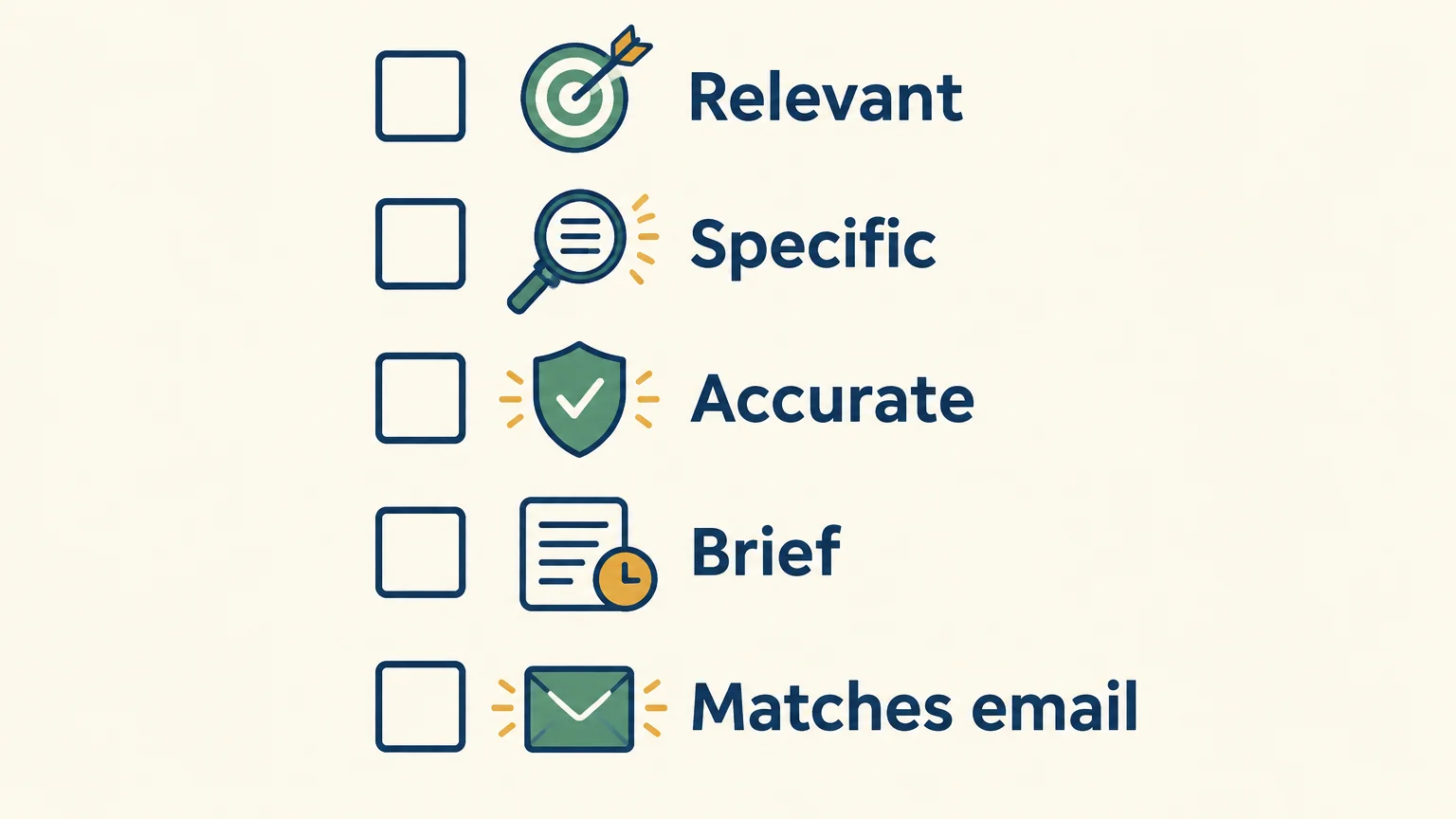
Before sending, read the subject and email body together. Check whether the subject reflects the actual message, whether the detail is accurate, and whether the recipient can understand the topic without decoding a clever phrase. This quick review is more useful than selecting a line because it sounds catchy in isolation.
- Is the topic relevant to this recipient and their business?
- Does the subject include a specific detail that you have verified?
- Can someone understand it quickly on a small screen?
- Does the email explain the connection suggested by the subject?
- Have you removed misleading urgency or a false implication of prior contact?
If you are testing alternatives, change one element at a time, such as the business detail or the wording. Compare results across similar groups and use a meaningful outcome, such as relevant replies, rather than assuming that opens alone show whether the email worked. Keep the version that attracts the right kind of attention without weakening the fit between subject and message.
Conclusion
The strongest cold email subject lines make a specific, truthful connection between the recipient’s business and the email’s purpose. Choose a verifiable detail, keep the wording easy to scan, and ensure the message delivers what the subject implies. Use examples as adaptable starting points, then review the line against the actual email before sending.
Prepare more relevant outreach, one lead at a time
Consultants who want a steadier way to find relevant B2B companies can use our researched briefs as a starting point. Each brief includes source information, reasons a company may need your service, suggested subject lines, an email draft, and practical conversation tips. These details can help you build a more specific introduction around a business context worth reviewing.
After signup, we provide one free researched brief without a card. Ongoing access is available through Starter at $49 per month for up to 10 requested leads in one daily brief, or Pro at $99 per month for up to 20. You review the evidence, qualify each company, find or verify contacts, personalize the draft, and send it through your own email account. Get your free researched brief.
Frequently Asked Questions
What is a good cold email subject line?
A good subject line is relevant to the recipient, easy to understand, and consistent with the message. A specific, verified business detail can make it more useful than a generic claim.
Should you put the recipient’s name in the subject line?
Use a name only when it feels natural and is accurate. A meaningful business detail often gives the recipient clearer context than a name inserted by itself.
How long should a cold email subject line be?
Keep it concise enough to scan quickly, while retaining the detail that explains the topic. Preview it on a phone and desktop rather than relying on one fixed character limit.
Should a cold email subject line be a question?
A question can work when it is focused and relevant to the email’s purpose. Do not use a question merely to create curiosity if the body does not answer it.
Can you use the same subject line for every prospect?
A shared structure can save time, but the subject should still reflect the recipient and message. Replace generic placeholders with accurate details, or use a clearer general subject when you have no verified context.